Today's
EarthStation1.com 15% (Or More!) Off Commemorative Memorial Title:
Spanish-American War & Cuban War Of Independence DVD,
Download, USB
Today, July 19, 2026
July 19: National Daiquiri Day: -- Each
year on July 19th, people across the United States fill their
glasses with a rum-based cocktail and toast to National Daiquiri
Day. So, raise your glass and join all of the others in this
celebration! Daiquiri is a family of cocktails whose main
ingredients are rum, citrus juice (typically lime), and sugar.
Tasting of sunshine and beaches, it might be hard to believe how
the Daiquiri came to be. Back in 1898, men blasted away in the
mines of a small community off the coast of Cuba during the
Spanish-American War. One American engineer, Jennings Cox,
supervised a mining operation located in a village named Daiquiri.
Every day after work, Cox and his employees would gather at the
Venus bar. Then one day, Cox mixed up Bacardi, lime, and sugar in
a tall glass of ice. He named the new beverage after the Daiquiri
mines, and the drink soon became a staple in Havana. Eventually,
someone added shaved ice, and sometimes lemons or both lemons and
limes were used. In 1909, Admiral Lucius W. Johnson, a U.S. Navy
medical officer, tried Cox's drink and subsequently introduced it
to the Army and Navy Club in Washington, D.C. The popularity of
the Daiquiri then increased over the next few decades. The
Daiquiri was one of the favorite drinks of writer Ernest Hemingway
and President John F. Kennedy. While the Daiquiri is sometimes
served frozen, combining it in a blender eliminates the need for
manual pulverization. Commercial machines produce a daiquiri with
a texture similar to a smoothie, and they come in a variety of
flavors, too. Using a frozen limeade to create a daiquiri will
provide the required texture, sweetness, and sourness all at the
same time. To observe National Daiquiri Day: Gather your friends
and mix up a few daiquiris! Make them blended or on the rocks.
Enjoy them as a mocktail or find a recipe for a daiquiri-flavored
dessert. (Remember always to drink responsibly and never to drink
and drive). On Sale Until Midnight Tonight PT!
https://store.earthstation1.com/spanishamerican-war-films-dvd.html
Today's
EarthStation1.com 15% (Or More!) Off Commemorative Memorial Title:
Old Time Kids Films Youth Social Guidance Films Set DVD, MP4, USB
Today, July 19, 2026
July 19: National Play Day: -- The
perfect day to unleash your inner child, spark your creativity,
and learn why play is an important part of living a happy life!
Play is one of the most simple, yet rewarding activities you can
do. It unlocks curiosity and allows you to explore the world in an
engaging way. Besides being fun, play opens a sense of enjoyment
that is essential for development and overall well-being. In fact,
play can actually help build problem-solving skills to help
navigate challenges we face in life. The next time someone says
play is just for kids, tell them they are wrong. Playing is a
biological need in our DNA that helps the brain develop. In fact,
we become smarter, stronger, and happier each time we play. Some
research even suggests we all have the play gene in our bodies
called the RT1 gene, or rough and tumble gene. This gene
apparently influences how much someone loves physical play. The
stronger the gene, the more the person loves playful experiences.
Play is a part of our core that has been shaped by evolution over
time. Playing 1) Improves brain function by building neural
connections, boosts imagination and learning, and reduces stress;
2) Supports a healthy body by promoting physical activity and
coordination, encourages mental development and growth, and
improves motor skills; 3) Provides emotional and social benefits
by teaching teamwork and compromise, builds self-esteem, and
provides a healthy outlet for expression; and 4) Creates a love of
learning by teaching problem-solving skills, stimulates innovative
ideas, and builds a resilience to adaptability to change. How we
play depends on who we are and our age. For kids, play means
learning to be creative and building strength in the mind and
body. For adults, it's how we socialize and make friends. In fact,
adults who play have a lower stress level because they allow
themselves to relax and recharge from the daily grind! On Sale
Until Midnight Tonight PT!
https://store.earthstation1.com/old-time-kids-films-youth-social-guidance-films-dual-layer-dvd.html
Today's
EarthStation1.com 15% (Or More!) Off Commemorative Memorial Title:
The Freshman (1925) Sound Edition + His Royal Slyness MP4 Download
DVD
Today, July 19, 2026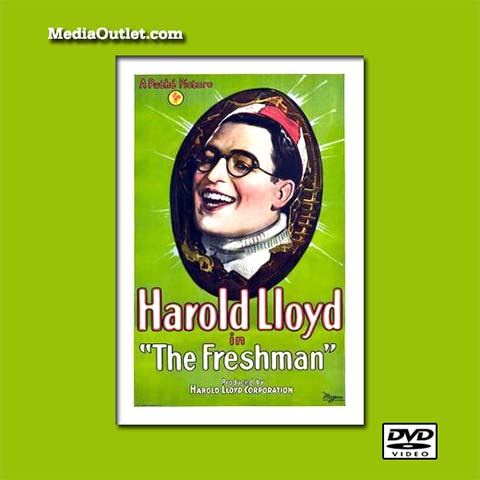
July 19: National Football Day: -- Honors
the most popular sport while also reminding us we're in the middle
of the season and should check in on our fantasy teams. Learn more
about how enthusiastic Americans are about football by reading top
football journalist tales. Football is an excellent way to stay in
shape and improve your reflexes. Kick a ball around in the yard
with your friends or start a game. Now is the time to get a ball,
if you don't already have one, and make your plans for
commemorating this wonderful American pastime. A popular sport in
North America, the sport is recognized as 'football' in the United
States and Canada, but it is also known as 'gridiron' or 'American
football' in other parts of the world. In the late 1800s, rugby
and soccer both paved the way for American football. Walter Camp,
a Yale graduate, was credited for establishing the line of
scrimmage, down-and-distance regulations (such as "first and
10"), and the authorization of blocking. Coaches like Knute
Rockne and Amos Alonzo Stagg later used the new "ahead pass"
play. Prior to it, in 1820, Princeton students were playing a game
known as 'ballown,' which means 'batting of the bladder with
fists.' The game involved batting the ball with a fist to keep it
in motion. There were no clear and fast regulations, and it was
regarded as the simplest version of football. However, the game
fell into obscurity during the Civil War. A football-style game
was also held at Harvard on the first Monday of the academic year.
This game was so physically demanding that the day it was played
was dubbed "Bloody Monday." The year 1865 was pivotal in
the development of American football. After the Civil War,
football gained popularity in many universities. The game's
essential rules were developed, and the game received its first
patent. On November 6, 1869, Rutgers and Princeton played the
first intercollegiate football game, with Rutgers winning by a
score of six goals to four. American Football has developed from a
simple game of tossing or kicking a ball past opponents to a game
that has influenced American culture and economics. On Sale Until
Midnight Tonight PT!
https://store.earthstation1.com/the-freshman-1925-dvd-special-edition-plus-his-royal-sly1925.html
Today's
EarthStation1.com 15% (Or More!) Off Commemorative Memorial Title:
Aviation History Films Collection DVD MP4 Video Download
Today, July 19, 2026
July 19: Flight Attendant Safety
Professionals' Day: -- The day is marked to appreciate flight
attendants for the important work they do during flights. The
holiday was proclaimed on July 13, 1990, by President George Bush.
Flight attendants strive to make air travel as comfortable and
enjoyable as possible as well as guard the safety of aircraft
passengers. Their professionalism has saved many passengers from
injury or death and continues to increase the margin of safety.
Flight Attendant Safety Professionals' Day was created by
proclamation of the President of the United States of America on
July 13, 1990. Declared by President George Bush during his
tenure, the proclamation enumerates the importance of flight
attendants to passenger safety. Flight attendants strive to make
air travel as comfortable and enjoyable as possible. Their chief
responsibility, however, is to guard the safety of aircraft
passengers. Federal aviation regulations entrust flight attendants
with an array of duties that are essential to protecting cabin
occupants from in-flight hazards and ensuring their safe
evacuation in the event of an emergency. The men and women who
serve as flight attendants carry out their duties with an
outstanding degree of dedication. Their behavior has been calm and
professional during accidents, hijackings, in-flight fires, sudden
cabin decompression, and other situations of potential or
immediate danger to human life. This tradition of professionalism
has saved many passengers from injury or death and continues to
increase the margin of safety for those who travel by air today.
On Sale Until Midnight Tonight PT!
https://store.earthstation1.com/aviation-history-films-2-dual-layer-dvd-se2.html
Today's
EarthStation1.com 15% (Or More!) Off Commemorative Memorial Title:
Unidentified Flying Objects 1956 Movie/Bonus Al Chop Interview MP4
DVD
Today, July 19, 2026
July 19/20, 1952: Unidentified Flying
Objects (UFOs, Unidentified Anomalous Phenomenon, UAPs): UFO
Incidents (Unidentified Flying Object Incidents): UFO Aviation
Incidents (Unidentifed Flying Object Aviation Incidents): The 1952
Washington, D.C. UFO Incident (The Washington Flap, The Washington
National Airport Sightings, The Invasion Of Washington): -- The
largest, most famous and most significant UFO "flap"occurs
as a series of unidentified flying objects are encounted between
July 12-29, 1952, over Washington, D.C. The most publicized
sightings took place on consecutive weekends, July 19-20 and July
26-27. UFO historian Curtis Peebles called the incident "the
climax of the 1952 (UFO) flap" - "Never before or after
did Project Blue Book and the Air Force undergo such a tidal wave
of (UFO) reports." ========= The 1952 Washington, D.C. UFO
Incident: The Events of July 19-20: -- At 11:40 p.m. on Saturday,
July 19, 1952, Edward Nugent, an air traffic controller at
Washington National Airport (today Ronald Reagan Washington
National Airport), spotted seven objects on his radar. The objects
were located 15 miles (24 km) south-southwest of the city; no
known aircraft were in the area and the objects were not following
any established flight paths. Nugent's superior, Harry Barnes, a
senior air-traffic controller at the airport, watched the objects
on Nugent's radarscope. He later wrote "We knew immediately
that a very strange situation existed . . . their movements were
completely radical compared to those of ordinary aircraft."
Barnes had two controllers check Nugent's radar; they found that
it was working normally. Barnes then called National Airport's
radar-equipped control tower; the controllers there, Howard
Cocklin and Joe Zacko, said that they also had unidentified blips
on their radar screen, and saw a hovering "bright light"
in the sky, which departed with incredible speed. Cocklin asked
Zacko, "Did you see that? What the hell was that?" At
this point, other objects appeared in all sectors of the
radarscope; when they moved over the White House and the United
States Capitol, Barnes called Andrews Air Force Base, located 10
miles from National Airport. Although Andrews reported that they
had no unusual objects on their radar, an airman soon called the
base's control tower to report the sighting of a strange object.
Airman William Brady, who was in the tower, then saw an "object
which appeared to be like an orange ball of fire, trailing a tail
. . . [it was] unlike anything I had ever seen before." As
Brady tried to alert the other personnel in the tower, the strange
object "took off at an unbelievable speed. On one of National
Airport's runways, S.C. Pierman, a Capital Airlines pilot, was
waiting in the cockpit of his DC-4 for permission to take off.
After spotting what he believed to be a meteor, he was told that
the control tower's radar had detected unknown objects closing in
on his position. Pierman observed six objects - "white,
tailless, fast-moving lights" - over a 14-minute period.
Pierman was in radio contact with Barnes during his sighting, and
Barnes later related that "each sighting coincided with a pip
we could see near his plane. When he reported that the light
streaked off at a high speed, it disappeared on our scope."
Meanwhile, at Andrews Air Force Base, the control tower personnel
were tracking on radar what some thought to be unknown objects,
but others suspected, and in one instance were able to prove, were
simply stars and meteors. However, Staff Sgt. Charles Davenport
observed an orange-red light to the south; the light "would
appear to stand still, then make an abrupt change in direction and
altitude . . . this happened several times." At one point
both radar centers at National Airport and the radar at Andrews
Air Force Base were tracking an object hovering over a radio
beacon. The object vanished in all three radar centers at the same
time. At 3 a.m., two United States Air Force F-94 Starfire jet
fighter interceptors from New Castle Air Force Base in Delaware
were scrambled to intercept the objects. The Lockheed F-94
Starfire was a first-generation jet powered all-weather day/night
interceptor aircraft was the first operational United States Air
Force fighter equipped with an afterburner, enabling the planes to
arrive at the scene with the greatest airspeed available at the
time. Shortly before the jets arrived over Washington, all of the
objects vanished from the radar at National Airport. However, when
the jets ran low on fuel and left, the objects returned, which
convinced Barnes that "the UFOs were monitoring radio traffic
and behaving accordingly." The objects were last detected by
radar at 5:30 a.m. The sightings of July 19-20, 1952, made
front-page headlines in newspapers around the nation. A typical
example was the headline from the Cedar Rapids Gazette in Iowa. It
read "SAUCERS SWARM OVER CAPITAL" in large black type.
By coincidence, USAF Captain Edward J. Ruppelt, the supervisor of
the Air Force's Project Blue Book investigation into UFO
sightings, was in Washington at the time. However, he did not
learn about the sightings until Monday, July 21, when he read the
headlines in a Washington-area newspaper. After talking with
intelligence officers at the Pentagon about the sightings, Ruppelt
spent several hours trying to obtain a staff car so he could
travel around Washington to investigate the sightings, but was
refused as only generals and senior colonels could use staff cars.
He was told that he could rent a taxicab with his own money; by
this point Ruppelt was so frustrated that he left Washington and
flew back to Blue Book's headquarters at Wright-Patterson AFB in
Dayton, Ohio. On Sale Until Midnight Tonight PT!
https://store.earthstation1.com/unidentified-flying-objects-the-true-story-of-flying-saucers-dvd.html
Today's
EarthStation1.com 15% (Or More!) Off Commemorative Memorial Title:
The X Planes TV Documentary Series DVD, MP4, USB Drive
Today, July 19, 2026
July 19, 1963: Aviation: The History Of
Aviation: Aviation Records: Flight Altitude Records: X-15 Flight
90: -- Joe Walker flies a North American X-15 to a record altitude
of 106,010 meters (347,800 feet / 65.87 miles) on X-15 Flight 90;
exceeding an altitude of 100 km, this flight qualifies as a human
spaceflight under international convention, and thereby Joe Walker
becomes the first known person to fly into outer space.
Thereafter, the USAF awarded astronaut wings to anyone achieving
an altitude of 50 miles (80 km), while the FAI (Federation
Aeronautique Internationale, English: The World Air Sports
Federation), the world governing body for air sports since it was
founded in Paris in 1905, set the limit of space at 100 kilometers
(62.1 mi), the height Walker exceeded with this flight. X-15
Flight 90 of the North American X-15 was a test flight conducted
by NASA and the US Air Force in 1963. It was the first of two X-15
missions that reached space, along with Flight 91 the next month.
The X-15 was flown by Joseph A. Walker, who flew both X-15
spaceflights. The North American X-15 was a hypersonic
rocket-powered aircraft operated by the United States Air Force
and the National Aeronautics and Space Administration as part of
the X-plane series of experimental aircraft. The X-15 set speed
and altitude records in the 1960s, reaching the edge of outer
space and returning with valuable data used in aircraft and
spacecraft design. The X-15's official world record for the
highest speed ever recorded by a manned, powered aircraft, set in
October 1967 when William J. Knight flew Mach 6.72 at 102,100 feet
(31,120 m), a speed of 4,520 miles per hour (7,274 km/h; 2,021
m/s), has remained unchallenged as of July 2021. On Sale Until
Midnight Tonight PT!
https://store.earthstation1.com/the-x-planes-tv-documentary-series-dvd-mp4-usb-driv4.html
Today's
EarthStation1.com 15% (Or More!) Off Commemorative Memorial Title:
Great Comet Crash: Shoemaker-Levy 9 Live + Doomsday Asteroid MP4
DVD
Today, July 19, 2026
July 19, 1994: Space: Outer Space:
Astronomy: The Solar System: Small Solar System Bodies (SSSBs):
Comets: Destroyed Comets: Comet Shoemaker-Levy 9 (D/1993 F2): --
Two Shoemaker-Levy 9 fragments impact the planet Jupiter 12 hours
apart, creating impact marks of similar size to that caused by the
day prior by fragment G of Shoemaker-Levy at 07:33 UTC, the
largest impact of Shoemaker-Levy 9, which struck Jupiter with an
impact that created a giant dark spot over 12,000 km or 7,500 mi
(almost one Earth diameter) across, estimated to have released an
energy equivalent to 6,000,000 megatons of TNT (600 times the
world's nuclear arsenal). On July 16, 1994, the first fragment of
comet Shoemaker-Levy 9's nucleus, fragment A, was destroyed in a
head-on collision into Jupiter's southern hemisphere at 20:13 UTC
at about 60 km/s (35 mi/s). Instruments on the American robotic
space probe Galileo, which was on its way to Jupiter to study the
planet and its moons, detected a fireball that reached a peak
temperature of about 24,000 K (23,700 dg C; 42,700 dg F), compared
to the typical Jovian cloud-top temperature of about 130 K (-143
dg C; -226 dg F). It then expanded and cooled rapidly to about
1,500 K (1,230 dg C; 2,240 dg F). The plume from the fireball
quickly reached a height of over 3,000 km (1,900 mi) and was
observed by the low Earth orbit Hubble Space Telescope (HST). Over
the next six days, 21 distinct impacts were observed, with the
largest coming on July 18 at 07:33 UTC when fragment G struck
Jupiter. Two impacts 12 hours apart on July 19 created impact
marks of similar size to that caused by fragment G, and impacts
continued until July 22, when fragment W struck the planet. Comet
Shoemaker-Levy 9 (formally designated D/1993 F2) was a comet that
broke apart in July 1992 and collided with Jupiter between July 16
and 22, 1994, providing the first direct observation of an
extraterrestrial collision of Solar System objects. This generated
a large amount of coverage in the popular media, and the comet was
closely observed by astronomers worldwide. The collision provided
new information about Jupiter and highlighted its possible role in
reducing space debris in the inner Solar System. The comet was
discovered by astronomers Carolyn and Eugene M. Shoemaker and
David Levy in 1993. Shoemaker-Levy 9 (SL9) had been captured by
Jupiter and was orbiting the planet at the time. It was located on
the night of March 24 in a photograph taken with the 46 cm (18 in)
Schmidt telescope at the Palomar Observatory in California. It was
the first active comet observed to be orbiting a planet, and had
probably been captured by Jupiter around 20-30 years earlier.
Calculations showed that its unusual fragmented form was due to a
previous closer approach to Jupiter in July 1992. At that time,
the orbit of Shoemaker-Levy 9 passed within Jupiter's Roche limit,
and Jupiter's tidal forces had acted to pull apart the comet. The
comet was later observed as a series of fragments ranging up to 2
km (1.2 mi) in diameter. These fragments collided with Jupiter's
southern hemisphere at a speed of approximately 60 km/s (37 mi/s)
(Jupiter's escape velocity) or 216,000 km/h (134,000 mph). The
prominent scars from the impacts were more easily visible than the
Great Red Spot and persisted for many months. On Sale Until
Midnight Tonight PT!
https://store.earthstation1.com/great-comet-crash-live-shoemakerlevy-9-jupiter-collisions-dvd-mp4-u94.html
Today's
EarthStation1.com 15% (Or More!) Off Commemorative Memorial Title:
The Western Tradition TV Series DVD, MP4 Video Download, USB Drive
Today, July 19, 2026
July 18/19, AD 64: Conflagrations:
Conflagrations In Ancient Rome: The Great Fire Of Rome (Latin:
Incendium Magnum Romae): -- The Great Fire Of Rome causes
widespread devastation and rages on for six days, destroying half
of the city. Differing accounts either blame Emperor Nero for
initiating the fire or credit him with organizing measures to
contain it and provide relief for refugees. According to Tacitus
and later Christians, Nero blamed the devastation on the Christian
community in the city, initiating the empire's first persecution
against the Christians. The varying historical accounts of the
event come from three secondary sources-Cassius Dio, Suetonius and
Tacitus. The primary accounts, which possibly included histories
written by Fabius Rusticus, Marcus Cluvius Rufus and Pliny the
Elder, did not survive. At least five separate stories circulated
regarding Nero and the fire: 1) Motivated by a desire to destroy
the city, Nero secretly sent out men pretending to be drunk to set
fire to the city. Nero watched from his palace on the Palatine
Hill singing and playing the lyre; 2) Nero quite openly sent out
men to set fire to the city. Nero watched from the Tower of
Maecenas on the Esquiline Hill singing and playing the lyre; 3)
Nero sent out men to set fire to the city. Nero sang and played
his lyre from a private stage; 4) The fire was an accident. Nero
was in Antium; and 5) The fire was said to have been caused by the
already unpopular Christians. This story was spread in order to
blame someone else, because rumor had it that Nero started it.
Tacitus describes the fire as beginning in shops where flammable
goods were stored, in the region of the Circus neighboring the
Caelian and Palatine Hills of Rome. The night was a windy one and
the flames rapidly spread along the full length of the Circus. The
fire expanded through an area of narrow, twisting streets and
closely located apartment blocks. In this lower area of ancient
Rome there were no large buildings such as temples, or open areas
of ground, to impede the conflagration. It then spread along the
Palatine and Caelian slopes. The population fled first to areas
unaffected by the fire and then to the open fields and rural roads
outside the city. Looters and arsonists were reported to have
spread the flames by throwing torches or, acting in groups, to
have hindered measures being made to halt or slow the progress of
the flames. Tacitus surmises that some may have acted under orders
or that they may simply have wanted to plunder unhindered.
According to Tacitus, Nero was away from Rome, in Antium, when the
fire broke out. He returned to the city and took measures to bring
in food supplies and open gardens and public buildings to
accommodate refugees. After six days the organized clearing of
built-up areas brought the conflagration to a halt before it
reached the Esquiline Hill. There was a further outbreak in the
Aemilian district, involving the destruction of temples and
arcades but less loss of life. However the fire was now under
control. According to Tacitus, of Rome's 14 districts, 3 were
completely devastated, 7 more were reduced to a few scorched and
mangled ruins and only 4 completely escaped damage. It is
postulated that the fire had been intentionally started to create
room for Nero's Domus Aurea, but the fire started 1 km (0.6 miles)
away from the site where this palace would later be built, on the
other side of the Palatine Hill. Moreover, the fire destroyed
parts of Nero's own palace, the Domus Transitoria. It seems
unlikely that Nero wanted to destroy this palace since he actually
salvaged some of the marble decoration and integrated it into the
new Domus Aurea. Even the paintings and wall decorations of the
new palace were similar to the ones that had been burned. Last,
the fire started just two days after a full moon, a time that, it
is presumed, would not have been chosen by arsonists who prefer
the cover of darkness. Due to the sparse mentions of Christian
persecution under Nero in Roman historiography (Cassius Dio wrote
about the Great Fire but did not mention Christians) and the lack
of evidence that Christians were distinguished from Jews at the
time, such persecution has been considered by some modern
historians as open to question. On Sale Until Midnight Tonight PT!
https://store.earthstation1.com/the-western-tradition-dvd-set-all-52-shows-13-d5213.html
Today's
EarthStation1.com 15% (Or More!) Off Commemorative Memorial Title:
Air Power WWII TV Series With Walter Cronkite DVD, Video Download,
USB
Today, July 19, 2026
July 19, 1943: The European Civil War:
World War II: The Second European War (The European Theater Of
World War II): The Mediterranean And Middle East Theater Of World
War II: The Italian Campaign Of World War II (The Liberation Of
Italy): The Winter Line: The Battle Of Rome (The Liberation Of
Rome): Air Warfare Of World War II: Strategic Bombing During World
War II: European Air Operations During The Battle Of Europe: The
Bombing Of Rome In World War II: Operation Crosspoint: -- The
first of a series of Allied aerial bombings of Rome occurs when it
is heavily bombed by 690 American aircraft, which dropped 9,125
bombs weighing 1,168 tons during Operation Crosspoint. Between 11
a.m. and 12 noon, 150 Allied B-17 Flying Fortresses attacked the
San Lorenzo freight yard and steel factory; the entire working
class district of San Lorenzo was destroyed. In the afternoon, the
second target and largest target was the Littorio marshalling yard
of Stazione Termini (Roma Termini Railway Station) and industries
that manufactured steel, textile products and glass on the
northern side of Rome. The third target was the Ciampino Airport,
on the south-east side of Rome. The raid caused thousands of
civilian casualties (estimates range between 1,600 and 3,200
victims) over five residential/railway districts. After the raid,
Pius XII, along with Msgr. Montini (the future Pope Paul VI),
travelled to the Basilica of Saint Lawrence outside the Walls,
which had been badly damaged, and distributed 2 million lire to
the crowds. The bombings of the "Eternal City" were
controversial for several reasons. General Henry H. Arnold
described Vatican City as a "hot potato" because of the
importance of Catholics in the U.S. Armed Forces. Rome had been
the capital city of Italy for around 70 years, but large parts of
the city were more than 2,500 years old. The neutral Vatican City
sat within Rome, and the Vatican also owned many churches and
other buildings outside its territory but within Rome city limits.
Many Americans were against a major destruction of Rome. British
public opinion, however, was more aligned towards the bombing of
the city, due to the participation of Italian planes in The Blitz
over London. The British War Cabinet refused to accept the
argument that bombing Rome was a crime against humanity, and H.G.
Wells was a particularly vocal proponent of doing so. Winston
Churchill approved the bombardment by the words "I agree,
W.S.C. 16.7.43.". The Bombing Of Rome In World War II took
place on several occasions in 1943 and 1944, primarily by Allied
and to a smaller degree by Axis aircraft, before the city was
invaded by the Allies on June 4, 1944. Pope Pius XII was initially
unsuccessful in attempting to have Rome declared an open city,
through negotiations with President Roosevelt via Archbishop
(later Cardinal) Francis Spellman. Rome was eventually declared an
open city on August 14, 1943 (a day after the last Allied bombing)
by the defending forces. In the 110,000 sorties that comprised the
Allied Rome air campaign, 600 aircraft were lost and 3,600 air
crew members died; 60,000 tons of bombs were dropped in the 78
days before Rome was captured by the Allies on June 4, 1944. On
Sale Until Midnight Tonight PT!
https://store.earthstation1.com/air-power-original-1950s-tv-series-walter-cronkite-4-dv19504.html
Today's
EarthStation1.com 15% (Or More!) Off Commemorative Memorial Title:
New York City History Documentary Collection MP4 Video Download
DVD
Today, July 19, 2026
July 19, 1845: Conflagrations:
Conflagrations In The United States: Urban Fires: Urban Fires In
The United States: Fires In New York City: The Great New York City
Fire Of 1845: -- The last great fire to affect Manhattan began
early in the morning and was subdued that afternoon. The fire
killed four firefighters, 26 civilians, and destroyed 345
buildings. The fire started in a whale oil and candle
manufacturing establishment, J. L. Van Doren, Oil Merchant and
Stearin Candle Manufacturer at 34 New Street in Manhattan, and
spread quickly to adjoining buildings. The City Hall alarm bell
began to ring at about 3:00 a.m., summoning firefighters. In the
fire's first two hours, it reached a large multi-story warehouse
occupied by Crocker and Warren on Broad Street, where a large
quantity of combustible saltpeter was stored. At about 3:30 or
4:00 a.m., the building exploded. The explosion flattened six to
eight buildings, blew in the fronts of the opposite houses on
Broad Street, and wrenched shutters and doors from buildings at
some distance from the immediate area. It propelled bricks and
other missiles through the air, threw many people down who had
gone as far as Beaver Street, and spread the fire far and wide so
that the whole neighborhood was set ablaze. The explosion
shattered windows a mile away and was heard as far away as Sandy
Hook, New Jersey. The cause of the explosion was debated in the
days immediately following the fire. Public speculation led to the
arrest of Crocker and Warren, the occupants of the warehouse. The
Daily-Tribune reported that the explosions could not have occurred
without the presence of gunpowder in addition to the saltpeter,
and thus they were suspected of possessing gunpowder, which would
have led to a murder charge. However, later inquiry released
Crocker and Warren of all charges as no evidence of gunpowder was
discovered. During the ten and a half hours that it burned, the
fire had destroyed buildings from Broad Street below Wall Street
to Stone Street, up Whitehall Street to Bowling Green, and up
Broadway to Exchange Place. Buildings were reported destroyed on
Broadway, New Street, Broad Street, Exchange Place, Beaver Street,
Marketfield Street, Whitehall Street, and South William Street.
All told, the fire destroyed 345 buildings in the southern part of
what is now the Financial District, resulting in property damage
estimated at the time between 5M USD and 10M USD; today, those
damages would be between 131M USD and 263M USD. On Sale Until
Midnight Tonight PT!
https://store.earthstation1.com/new-york-city-history-videos-3-dvd-se3.html
Today's
EarthStation1.com 15% (Or More!) Off Commemorative Memorial Title:
La Belle Epoque 1890-1914 DVD, MP4 Video Download, USB Flash Drive
Today, July 19, 2026
July 19, 1900: Europe: The History Of
Europe: The Cultural History Of Europe: La Belle Epoque: (French:
"The Beautiful Epoch") (1871-1914): Fin De Siecle
(French: "The End Of The Century"; equivalent to English
"Turn Of The Century"): The History Of Rail Transport:
The History Of Rail Transportation In Europe: The History Of Rail
Transportation In France: In Europe: The History Of Rail
Transportation In Paris: Grand Openings: The Paris Metro (French:
Metro De Paris, short for Metropolitain): Paris Metro Line 1
(French: Ligne 1 Du Metro De Paris): -- The first line of the
Paris Metro, Paris Metro Line 1, opens for operation. Paris Metro
Line 1 is one of the sixteen lines of the Paris Metro. It connects
La Defense-Grande Arche in the northwest and Chateau de Vincennes
in the southeast. Also, there is a future eastern extension
planned to go to Val de Fontenay to make a link with Paris Metro
Line 15, RER A, RER E and an extension of Tram 1. With a length of
16.5 km (10.3 mi), it constitutes an important east-west
transportation route within the City of Paris. Excluding RER
(French: Reseau Express Regional) commuter lines, it is the
busiest line on the network with 181.2 million travellers in 2017
or 496,000 people per day on average. The line was the network's
first to open, with its inaugural section entering service in
1900. It is also the network's first line to be converted from
manually driven operation to fully automated operation.
Conversion, which commenced in 2007 and was completed in 2011,
included new rolling stock (MP 05) and laying of platform edge
doors in all stations. The first eight MP 05 trains (501 through
508) went into passenger service on 3 November 2011, allowing the
accelerated transfer of the existing MP 89 CC stock to Line 4;
however, as of 2019, Line 4 is also being converted to automated
operations. The conversion allowed Line 1 to operate as the
system's second fully automated line, after Line 14. A transition
to fully automated services was done without major interruption to
passenger traffic. The new MP 05 rolling stock was able to operate
efficiently alongside the manually-driven MP 89 CC rolling stock
until there were enough MP 05 to no longer facilitate the need of
the MP 89. Full automation was achieved for evening services in
May 2012, with an increase to weekend services by August 2012. As
of 15 December 2012, Line 1 is fully automated. The remaining five
MP 89 CC trains remained stored on Line 1 near the Fontenay
workshops until a new garage for Line 4 was opened south of the
new Mairie de Montrouge station in February 2013. On Sale Until
Midnight Tonight PT!
https://store.earthstation1.com/la-belle-epoque-18901914-western-high-society-cul18901914.html
Today's
EarthStation1.com 15% (Or More!) Off Commemorative Memorial Title:
The Soviet-Afghan War DVD, MP4 Video Download, USB Flash Drive
Today, July 19, 2026
July 19, 1980: The Olympic Games (The
Olympics):The 1980 Summer Olympics (Russian: Letnije Olimpijskije
Igry 1980) (The Games Of The XXII Olympiad (Russian: Igry XXII
Olimpiady), Moscow 1980): -- The 1980 Summer Olympics opens in
Moscow, Russia, Soviet Union. The 1980 Summer Olympics (Russian:
Letnije Olimpijskije Igry 1980), officially known as the Games Of
The XXII Olympiad (Russian: Igry XXII Olimpiady) and commonly
known as Moscow 1980 (Russian: Moskva 1980), were an international
multi-sport event held from July 19 to August 3, 1980 in Moscow,
Soviet Union, in present-day Russia. The games were the first to
be staged in an Eastern Bloc country, as well as the first Olympic
Games and only Summer Olympics to be held in a Slavic
language-speaking country. They were also the only Summer Olympic
Games to be held in a socialist state until the 2008 Summer
Olympics held in China. These were the final Olympic Games under
the IOC Presidency of Michael Morris, 3rd Baron Killanin before he
was succeeded by Juan Antonio Samaranch, a Spaniard, shortly
afterwards. Eighty nations were represented at the Moscow Games,
the smallest number since 1956. Led by the United States, 66
countries boycotted the games entirely, because of the
Soviet-Afghan War. Several alternative events were held outside of
the Soviet Union. Some athletes from some of the boycotting
countries (not included in the list of 66 countries that boycotted
the games entirely) participated in the games under the Olympic
Flag. The Soviet Union later boycotted the 1984 Summer Olympics in
Los Angeles. The Soviet Union won the most gold and overall
medals, with the USSR and East Germany winning 127 out of 203
available golds. A Soviet stamp sheet showing the logo of the
games and its mascot Misha holding the 1980 Olympic torch. The map
shows the torch relay route from Olympia, Greece, the site of the
ancient Olympic Games, to Moscow, Russian SFSR. It also depicts
the number of gold, silver and bronze medals (80, 69, 46) won by
the Soviet athletes at the Games. The only two cities to bid for
the 1980 Summer Olympics were Moscow and Los Angeles. The choice
between them was made at the 75th IOC Session in Vienna, Austria
on October 23, 1974. Los Angeles would eventually host the 1984
Summer Olympics. On Sale Until Midnight Tonight PT!
https://store.earthstation1.com/the-sovietafghan-war-dvd-mp4-usb-driv4.html
Today's
EarthStation1.com 15% (Or More!) Off Commemorative Memorial Title:
Armada: Spanish Armada TV Series + Bonus MP4 Video Download DVD
Today, July 19, 2026
July 19, 1588: The European Wars Of
Religion: The Eighty Years' War (The Dutch Revolt): The
Anglo-Spanish Wars: The Anglo-Spanish War (1585-1604): The Spanish
Armada (The Invincible Armada, The Enterprise Of England [Spanish:
Grande Y Felicisima Armada, "Great And Most Fortunate
Navy"]): The Battle Of Gravelines (1588): -- The Spanish
Armada is first sighted from the British isles in the English
Channel off "The Lizard" (a corruption of the Cornish
"Lys Ardh", meaning "High Court"), a peninsula
in southern Cornwall, England (it is coincidental that much of the
peninsula is composed of serpentinite-bearing rock). The news was
conveyed to London by a system of beacons that had been
constructed all the way along the south coast. On this day, the
English fleet was trapped in Plymouth Harbour by the incoming
tide. The Spanish convened a council of war, where it was proposed
to ride into the harbour on the tide and incapacitate the
defending ships at anchor. From Plymouth Harbour the Spanish would
attack England, but Philip II explicitly forbade Medina Sidonia
from acting, leaving the Armada to sail on to the east and toward
the Isle of Wight. As the tide turned, 55 English ships set out to
confront the Armada from Plymouth under the command of Lord
Charles Howard, 1st Earl of Nottingham, with Sir Francis Drake as
Vice Admiral. The rear admiral was Sir John Hawkins. On Sale Until
Midnight Tonight PT!
https://store.earthstation1.com/armada-dvd-spanish-armada-tv-series-all-3-episode3.html
Today's
EarthStation1.com 15% (Or More!) Off Commemorative Memorial Title:
Winston Churchill: The Valiant Years TV Series DVD, MP4, USB Drive
Today, July 19, 2026
July 19, 1940: The European Civil War:
World War II: The Second European War (The European Theater Of
World War II): The Mediterranean And Middle East Theater Of World
War II: The Battle Of The Mediterranean: The Battle Of Cape Spada:
-- The Royal Navy and the Regia Marina engage in their first clash
of World War II off Cape Spada, the north-western extremity of
Crete in the Mediterranean Sea. The Italian light cruiser
Bartolomeo Colleoni sinks with 121 casualties; 555 survivors were
rescued. The battle occurred when an Allied squadron patrolling
the Aegean encountered two Italian cruisers transferring from
Tripoli to Leros, at that time an Italian colony in the Dodecanese
Islands. The Allied squadron was commanded by the Australian
Captain John Collins aboard the light cruiser HMAS Sydney and
included the British H class destroyers HMS Havock, Hyperion,
Hasty, Hero and the similar I class destroyer Ilex. The Italian
2nd Cruiser Division was commanded by Vice Admiral Ferdinando
Casardi and consisted of the high-speed light cruisers Giovanni
dalle Bande Nere and Bartolomeo Colleoni. When the Italians
encountered the Allied destroyers at about 07:30, Sydney and
Havock were 40 mi (35 nmi; 64 km) to the north on a sweep for
submarines. The other destroyers led the Italian cruisers on a
chase northwards to give Sydney time to come to the rescue. Sydney
sighted the Italians at 08:26, opening fire at 08:29, and the
Italian cruisers turned away to the southwest. In the running
battle which followed, Bartolomeo Colleoni was hard hit by Sydney
and after a shell hit the boilers at 09:23 she stopped dead in the
water. She fought on but was unable to manoeuvre or use the main
battery; despite the fire from her 100 mm (3.9 in) guns, she was
sunk by three torpedoes launched from Ilex and Hyperion at 09:59.
Sydney continued to fire against Bande Nere. She was hit in the
funnel by a single Italian shell, but managed to hit Bande Nere at
least twice, killing eight in the bow and the hangar. Later,
Sydney disengaged because she was short of ammunition and Giovanni
delle Bande Nere returned to Benghazi, shadowed by the battleship
HMS Warspite and a screen of destroyers. The British destroyers
were bombed by Italian aircraft in the aftermath, resulting in
damage to HMS Havock, whose No. 2 boiler was flooded. A floatplane
from Warspite, which was searching for Bande Nere, ditched in the
sea and was lost near Tobruk. The crew was captured by the
Italians. Allied convoy AN.2 was ordered to sail back to Port Said
and remain there until it was eventually known that Bande Nere had
reached Benghazi. Despite their speed advantage, the Italian
cruisers failed to outrun HMAS Sydney because they had to steer
south-southwest, instead of the most obvious route of escape to
the south, in order to avoid being trapped between the enemy and
the shores of Crete. This gave the Australian cruiser the chance
to close the range, as she did. The light armour of Colleoni and
Bande Nere was unable to defeat Sydney's rounds. The lack of
aerial reconnaissance was another factor contributing to the
successful Allies' chase. On Sale Until Midnight Tonight PT!
https://store.earthstation1.com/winston-churchill-the-valiant-years-dvd-set-all-26-shows-7-d267.html
Today's
EarthStation1.com 15% (Or More!) Off Commemorative Memorial Title:
The Great War (1964) TV Documentary Series DVD, Video Download,
USB
Today, July 19, 2026
July 19, 1916: The European Civil War:
World War I: The First European War (The European Theater Of World
War I): The Western Front Of World War I: The Battle Of The Somme
(The Somme Offensive, The First Battle Of The Somme): The Attack
At Fromelles (The Battle Of Fromelles, The Battle Of Fleurbaix,
Schlacht Von Fromelles): -- In what the Australian War Memorial
describes as "the worst 24 hours in Australia's entire
history", the Australian Imperial Force (AIF) debuts on the
Western Front as they and British troops attack German trenches as
part of the Battle Of The Somme. Of 7,080 BEF casualties, 5,533
were suffered by the 5th Australian Division; the Germans lost
1,600-2,000 men and 150 prisoners. The Attack at Fromelles, also
known as the Battle Of Fromelles, Battle of Fleurbaix or Schlacht
von Fromelles (19-20 July 1916) was a British military operation
on the Western Front during the First World War, subsidiary to the
Battle Of The Somme. General Headquarters (GHQ) of the British
Expeditionary Force (BEF) had ordered the First and Second armies
to prepare attacks to support the Fourth Army on the Somme 50 mi
(80 km) to the south, to exploit any weakening of the German
defences opposite. The attack took place 9.9 mi (16 km) from
Lille, between the Fauquissart-Trivelet road and Cordonnerie Farm,
an area overlooked from Aubers Ridge to the south. The ground was
low-lying and much of the defensive fortification by both sides
consisted of breastworks (a temporary earthwork fortification
thrown up to breast height) rather than trenches. The operation
was conducted by XI Corps of the First Army with the 61st (2nd
South Midland) Division and the 5th Australian Division,
Australian Imperial Force (1st AIF) against the 6th Bavarian
Reserve Division, supported by two flanking divisions of the
German 6th Army. Preparations for the attack were rushed, the
troops involved lacked experience in trench warfare and the power
of the German defence was significantly underestimated, the
attackers being outnumbered 2:1. The advance took place in
daylight on a narrow front against defences overlooked by Aubers
Ridge, which left German artillery on either side free to fire
into the flanks of the attack. A renewal of the attack by the 61st
Division early on 20 July was cancelled, after it was realised
that German counter-attacks had already forced a retirement by the
Australian troops to the original front line. On Sale Until
Midnight Tonight PT!
https://store.earthstation1.com/the-great-war-dvd-set-1964-wwi-tv-series-26-shows-1964266.html
Today's
EarthStation1.com 15% (Or More!) Off Commemorative Memorial Title:
The African-American Civil War 54th Massachusetts Infantry DVD MP4
USB
Today, July 19, 2026
July 19, 1863: The American Civil War
(The Civil War, The War Between The States): The Western Theater
Of The American Civil War: The Battles Of The Lower Seaboard
Theater And Gulf Approach Of The American Civil War: Operations
Against The Defenses Of Charleston During The American Civil War:
The Battles Of Fort Wagner: The Second Battle Of Fort Wagner (The
Second Assault On Morris Island; The Battle Of Fort Wagner, Morris
Island): -- Union troops made a second attempt to capture Fort
Wagner near Charleston, South Carolina. The attack was led by the
54th Massachusetts Colored Infantry, commanded by Colonel Robert
Gould Shaw, who was killed while leading his men to the parapet of
the enemy along with half of the 600 men in the regiment. This
battle marked the first use of black Union troops in the war, and
their story is dramatized in the 1989 film Glory, starring Matthew
Broderick and Denzel Washington. On Sale Until Midnight Tonight
PT!
https://store.earthstation1.com/the-africanamerican-civil-war-54th-massachusetts-infantry-dvd-mp4-544.html
Today's
EarthStation1.com 15% (Or More!) Off Commemorative Memorial Title:
Black Civil Rights Films: African-American History DVD, MP4, USB
Stick
Today, July 19, 2026
July 19, 1919: White Supremacy:
Terrorism: Anti-Black Racism: Anti-Black Racism In The United
States: Race Riots: Race Riots In The United States: The Nadir Of
American Race Relations (1877/1890 - 1901/1923/1941 [Dates
Disputed]): The First Red Scare: Red Summer: The Washington Race
Riot Of 1919: -- Six days of rioting begin in Washington, D.C.,
killing some fifteen people and wounding some one hundred fifty.
========= The Washington Race Riot Of 1919 was a civil unrest race
riot in Washington, D.C. from July 19, 1919, to July 24, 1919.
Starting July 19, white men, many in the United States Army,
United States Navy, and United States Marine Corps, responded to
the rumored arrest of a black man for rape of a white woman with
four days of mob violence against black individuals and
businesses. They rioted, randomly beat black people on the street,
and pulled others off streetcars for attacks. When police refused
to intervene, the black population fought back. The city closed
saloons and theaters to discourage assemblies. Meanwhile, the four
white-owned local papers, including the Washington Post, fanned
the violence with incendiary headlines and calling in at least one
instance for mobilization of a "clean-up" operation.
After four days of police inaction, President Woodrow Wilson
ordered 2,000 federal troops to regain control in the nation's
capital. But a violent summer rainstorm had more of a dampening
effect. When the violence ended, 15 people had died: at least 10
white people, including two police officers; and around 5 black
people. Fifty people were seriously wounded and another 100 less
severely wounded. It was one of the few times in 20th-century
riots of whites against blacks that white fatalities outnumbered
those of black people. The unrest was also one of the Red Summer
riots in America. ========= Red Summer is the period from late
winter through early autumn of 1919 during which white supremacist
terrorism and racial riots took place in more than three dozen
cities across the United States, as well as in one rural county in
Arkansas. The term "Red Summer" was coined by civil
rights activist and author James Weldon Johnson, who had been
employed as a field secretary by the National Association for the
Advancement of Colored People (NAACP) since 1916. In 1919, he
organized peaceful protests against the racial violence which had
occurred that summer. In most instances, attacks consisted of
white-on-black violence. However, numerous African Americans also
fought back, notably in the Chicago and Washington, D.C. race
riots, which resulted in 38 and 15 deaths, respectively, along
with even more injuries, and extensive property damage in Chicago.
Still, the highest number of fatalities occurred in the rural area
around Elaine, Arkansas, where an estimated 100-240 black people
and five white people were killed-an event now known as the Elaine
massacre. The anti-black riots developed from a variety of
post-World War I social tensions, generally related to the
demobilization of both black and white members of the United
States Armed Forces following World War I; an economic slump; and
increased competition in the job and housing markets between
ethnic European Americans and African Americans. The time would
also be marked by labor unrest, for which certain industrialists
used black people as strikebreakers, further inflaming the
resentment of white workers. The riots and killings were
extensively documented by the press, which, along with the federal
government, feared socialist and communist influence on the black
civil rights movement of the time following the 1917 Bolshevik
Revolution in Russia. They also feared foreign anarchists, who had
bombed the homes and businesses of prominent figures and
government leaders. On Sale Until Midnight Tonight PT!
https://store.earthstation1.com/black-civil-rights-films-africanamerican-history-dvd.html
Today's
EarthStation1.com 15% (Or More!) Off Commemorative Memorial Title:
America: The Second Century Documentary Series DVD, Download, USB
Today, July 19, 2026
July 19, 1941: Civil Rights Movements:
The American Civil Rights Movement (1896-1954) (The Jim Crow Era):
The March On Washington Movement (MOWM) (1941-1946): -- Under
pressure from A. Philip Randolph and other leaders of the March On
Washington Movement, President Franklin Roosevelt establishes the
Fair Employment Practices Committee to monitor discrimination
against Negroes in defense industries. On June 25 of that year,
Randolph and MOWM pressured President Roosevelt to issue an
executive order that would prohibit ethnic or racial
discrimination in the nation's defense industry as well as in
companies, unions, and federal agencies; otherwise, MOWM would
continue with their plans for a The March On Washington to demand
these things. Accordingly, President Roosevelt issued on Executive
Order 8802 on that date to that effect, and in response, MOWM
suspended the march. Two weeks prior to that, on June 18, 1941,
President Roosevelt had met with MOWM leaders to urge them to call
off their planned March Of Washington demonstration scheduled for
July 1, 1941. Randolph leader of the large Black railroad workers
union The Brotherhood Of Sleeping Car Porters, refused to call it
off, forcing President Roosevelt's hand. Randolph was concerned by
the discrimination against Black workers in defense industry
hiring. In a 1940 issue of The Pittsburgh Courier, Randolph
demanded the right for Black Americans "to work and fight for
[their] country." In January 1941, Randolph formed The March
On Washington Movement (MOWM). The first objective of the movement
was to bring 10,000 Black Americans to gather at the Lincoln
Memorial on July 1, 1941 to protest racial discrimination in the
military and defense industries. Later, the target size of the
march was increased ten-fold to a march of 100,000 Black
Americans. Other Black leaders of the MOWM included secretary of
the NAACP Walter White, leader of the National Urban League T.
Arnold Hill, the leader of the National Council of Negro Women
Mary McLeod Bethune, and more. With the stated July 1 date for the
MOWM impending, the Roosevelt administration rushed to negotiate
with the MOWM's leaders. First-lady Eleanor Roosevelt sent
Randolph a letter stating that the planned march was a "grave
mistake," but she received no reply from Randolph. Other
members of the Roosevelt administration urged defense industry
factories to stop discrimination against Black workers, but
Randolph stated that he would only call off the march if an
executive order was issued. Anxious to stop the march, Roosevelt
enlisted the help of civil rights activist during the New Deal
Aubrey Williams and labor expert Anna M. Rosenberg. They helped
organize a meeting of the leaders of the MOWM with Roosevelt at
the White House. The meeting quickly came to an impasse. In
response to Randolph's demand for an executive order, Roosevelt
replied: "Well Phil, you know I can't do that. If I issue an
executive order for you, then there'll be no end to other groups
coming in here and asking me to issue executive orders for them
too." On the other hand, the MOWM leaders refused to settle
for any action short of an executive order. Eventually, the
Roosevelt administration acquiesced. A series of meetings in both
New York and Washington resulted in the draft order. These
meetings involved Randolph and White discussing with Williams,
Rosenberg, and New York Mayor Fiorello La Guardia. The order was
drafted by Joseph Rauh. The March on Washington was suspended
after Executive Order 8802 was issued on June 25, 1941. On Sale
Until Midnight Tonight PT!
https://store.earthstation1.com/america-the-second-century-us-2nd-100-years-history-621006.html
Today's
EarthStation1.com 15% (Or More!) Off Commemorative Memorial Title:
Eyes On The Prize II: America At The Racial Crossroads DVD MP4 USB
Today, July 19, 2026
July 19, 1966: Civil Rights Movements:
The American Civil Rights Movement (1954-1968): The Ghetto Riots
(The Ghetto Rebellions, The Race Riots, The Negro Riots)
(1964-1969): The Hough Riots: -- Ohio Governor Rhodes declares a
state of emergency in Cleveland, and 1,700 Ohio National Guard
troops intervene to restore order. There were 275 arrests and
numerous incidents of arson and firebombings. The day prior, on
July 18, the six-day Hough Riots were sparked at the
Seventh-Niner's Cafe, a bar at the heart the predominantly African
American community of Hough (pronounced "Huff") in
Cleveland, Ohio, resulting in four African Americans killed and 50
people injured. City officials at first blamed black nationalist
and communist organizations for the riots, but historians
generally dismiss these claims today, arguing that the cause of
the Hough Riots were primarily poverty and racism. The riots
caused rapid population loss and economic decline in the area,
which lasted at least five decades after the riots. On Sale Until
Midnight Tonight PT!
https://store.earthstation1.com/eyes-on-the-prize-ii-dvd-set-4-discs-complete-2nd-seri42.html
Today's
EarthStation1.com 15% (Or More!) Off Commemorative Memorial Title:
Degas: Edgar Degas Documentary DVD, MP4 Download, USB Flash Drive
Today, July 19, 2026
July 19, 1834: #BOTD: #HBD! Edgar Degas,
French impressionist painter, sculptor, draftsman and printer (d.
September 27, 1917) is #born Hilaire-Germain-Edgar De Gas in
Paris, France. Degas is especially identified with the subject of
dance; more than half of his works depict dancers. He is regarded
as one of the founders of Impressionism, although he rejected the
term, preferring to be called a realist. He was a superb
draftsman, and particularly masterly in depicting movement, as can
be seen in his rendition of dancers, racecourse subjects and
female nudes. His portraits are notable for their psychological
complexity and for their portrayal of human isolation. At the
beginning of his career, Degas wanted to be a history painter, a
calling for which he was well prepared by his rigorous academic
training and close study of classic art. In his early thirties, he
changed course, and by bringing the traditional methods of a
history painter to bear on contemporary subject matter, he became
a classical painter of modern life. He apparently ceased working
in 1912, when the impending demolition of his longtime residence
on the rue Victor Masse forced him to move to quarters on
Boulevard de Clichy. He never married and spent the last years of
his life, nearly blind, restlessly wandering the streets of Paris
before dying of a brain aneurysm at the age of 83. He is buried at
Montmartre Cemetery in Paris, France. On Sale Until Midnight
Tonight PT!
https://store.earthstation1.com/degas-dvd-1988-tv-documentary-artist-edgar-d1988.html
Today's
EarthStation1.com 15% (Or More!) Off Commemorative Memorial Title:
Betty Boop: Boop-Oop-A-Doop With Steve Allen DVD, Download, USB
Drive
Today, July 19, 2026
July 19, 1883: #BOTD: #HBD! Max
Fleischer, Austrian-American animator, director and producer (d.
September 25, 1972) is #born Majer Fleischer to a Jewish family in
Krakow, Galicia, Austria-Hungary (now Poland). He is best known as
a co-owner of Fleischer Studios, an American animation studio
founded in New York City with his younger brother Dave Fleischer.
Fleischer Studios was an American corporation which originated as
an animation studio located at 1600 Broadway, New York City, New
York. It was founded in 1921 as Inkwell Studios by brothers Max
Fleischer and Dave Fleischer who ran the pioneering company from
its inception until Paramount Pictures, the studio's parent
company and the distributor of its films, acquired ownership. In
its prime, Fleischer Studios was a premier producer of animated
cartoons for theaters, with Walt Disney Productions's becoming its
chief competitor in the 1930s. Fleischer Studios is notable for
Koko the Clown, Betty Boop, Bimbo, Popeye the Sailor, and
Superman. Unlike other studios, whose characters were
anthropomorphic animals, the Fleischers' most successful
characters were humans (With the exception of Bimbo in the
1930s.). The cartoons of the Fleischer Studio were very different
from the Disney product, both in concept and in execution. As a
result, the Fleischer cartoons were rough rather than refined,
commercial rather than consciously artistic. But in their unique
way, their artistry was expressed through a culmination of the
arts and sciences. This approach focused on surrealism, dark
humor, adult psychological elements, and sexuality, and the
environments were grittier and urban, often set in squalid
surroundings, reflecting the Depression as well as German
Expressionism. Max Fleischer died from arterial sclerosis of the
brain in Los Angeles, California, two months after his 89th
birthday, and in announcing his passing the press dubbed him "Dean
Of Animated Cartoons". His remains were cremated, and his
ashes given to his widow Ethel "Essie" Goldstein. On
Sale Until Midnight Tonight PT!
https://store.earthstation1.com/betty-boop-boopoopadoop-dvd-steve-allen-documentary.html
Today's
EarthStation1.com 15% (Or More!) Off Commemorative Memorial Title:
Art In The Third Reich TV Series DVD, Video Download, USB Flash
Drive
Today, July 19, 2026
July 19, 1900: #BOTD: Arno Breker, German
sculptor who is best known for his public works in Nazi Germany,
where they were endorsed by the authorities as the antithesis of
degenerate art (d. February 13, 1991) is #born in Elberfeld,
Kingdom of Prussia, German Empire. He was made official state
sculptor, and exempted from military service. One of his better
known statues is Die Partei, representing the spirit of the Nazi
Party that flanked one side of the carriage entrance to Albert
Speer's new Reich Chancellery. After the fall of Nazi Germany in
1945 Breker continued to thrive professionally as a sculptor in
the new West Germany. The son of stonemason Arnold Breker, he
began hegan his career by studying architecture, along with
stone-carving and anatomy. At age 20 he entered the Dusseldorf
Academy of Arts where he concentrated on sculpture, studying under
Hubert Netzer and Wilhelm Kreis. He first visited Paris in 1924,
shortly before finishing his studies. There he met with Jean
Cocteau, Jean Renoir, Pablo Picasso, Daniel-Henry Kahnweiler, and
Alfred Flechtheim. In 1927 he moved to Paris, which he thereafter
considered to be his home, in the same year he had an exhibition
with Alf Bayrle. Breker was quickly accepted by the art dealer
Alfred Flechtheim. He also established close relationships with
important figures in the art world, including Charles Despiau,
Isamu Noguchi, Maurice de Vlaminck and Andre Dunoyer de Segonzac,
all of whom he later portrayed. He travelled to North Africa,
producing lithographs which he published under the title "Tunisian
Journey". He also visited Aristide Maillol, who was later to
describe Breker as "Germany's Michelangelo". In 1932, he
was awarded a prize by the Prussian Ministry of Culture, which
allowed him to stay in Rome for a year. In 1934 he returned to
Germany on the advice of Max Liebermann. At this time Alfred
Rosenberg, editor of the Nazi newspaper Volkischer Beobachter,
actually denounced some of Breker's work as degenerate art.
However, Breker was supported by many Nazi leaders, especially
Adolf Hitler. Even Rosenberg later hailed his sculptures as
expressions of the "mighty momentum and will power"
("Wucht und Willenhaftigkeit") of Nazi Germany. He took
commissions from the Nazis from 1933 through 1942, for example
participating in a show of his work in occupied Paris in 1942,
where he met Jean Cocteau, who appreciated his work. He maintained
personal relationships with Albert Speer and with Hitler. In 1936
he won the commission for two sculptures representing athletic
prowess, to be entered in the 1936 Olympic games arts competition
in Berlin, one representing a Decathlete ("Zehnkampfer"),
which won the silver medal for statues, and the other The Victress
("Die Siegerin"). In 1937 he married Demetra Messala, a
Greek model. The same year, Breker joined the Nazi Party and was
made "official state sculptor" by Hitler, given a large
property and provided a studio with forty-three assistants. Breker
was on a list of 378 "Gottbegnadeten" (divinely gifted)
artists exempted from wartime military duty by Hitler and chief
propagandist Joseph Goebbels. His twin sculptures The Party and
The Army held a prominent position at the entrance to Albert
Speer's new Reich Chancellery, as well as Josef Thorak's "Striding
Horses" (1939), which until 1945 flanked the entrance stairs
on the garden front of Adolf Hitler's Reich Chancellery in Berlin.
The neoclassical nature of his work, with titles like Comradeship,
Torchbearer, and Sacrifice, typified Nazi ideals, and suited the
characteristics of Nazi architecture. On closer inspection,
though, the proportions of his figures, the highly colouristic
treatment of his surfaces (the strong contrasts between dark and
light accents), and the melodramatic tension of their musculatures
perhaps invites comparison with the Italian Mannerist sculptors of
the 16th century. This Mannerist tendency to Breker's
neoclassicism may suggest closer affinities to concurrent
expressionist tendencies in German Modernism than is acknowledged.
Until the fall of the Third Reich, Breker was a professor of
visual arts in Berlin. Ninety percent of Breker's public works
were destroyed during the bombings of Germany toward the end of
the war. In 1946, Breker was offered a commission by Soviet leader
Joseph Stalin, but he refused, saying "One dictatorship is
sufficient for me". In 1948 Breker was designated as a
"fellow traveller" of the Nazis and fired, despite which
he continued to thrive professionally. He returned to Dusseldorf,
now in the new West Germany, which remained his base, with periods
of residence in Paris. During this time he worked as an architect.
However, he continued to receive commissions for sculptures,
producing a number of works in his familiar classical style,
working for businesses and individual patrons. He also produced
many portrait busts. In 1970 he was commissioned by the king of
Morocco to produce work for the United Nations Building in
Casablanca, but the work was destroyed. Many other works followed,
including sculptures for Dusseldorf's city hall, portraits of
Anwar Sadat and Konrad Adenauer, and a statue of Pallas Athene,
helmeted and throwing a spear in the same bombastic style as his
Nazi-era work. Breker's rehabilitation continued, culminating in
the creation of a Breker museum, funded by the Bodenstein family,
who set aside Schloss Norvenich (between Aachen and Cologne) for
the purpose. The Arno Breker Museum was inaugurated in 1985, and
still open in 2021.Breker's rehabilitation led to backlashes from
anti-Nazi activists, including controversy in Paris when some of
his works were exhibited at the Centre Georges Pompidou in 1981.
In the same year anti-Breker demonstrations accompanied an
exhibition in Berlin. Breker's admirers insisted that he had never
been a supporter of Nazi ideology, but had simply accepted their
patronage. Breker's last major work was a monumental sculpture of
Alexander the Great intended to be located in Greece. Arno Breker
was married twice. His first wife, Demetra Messala, was a Greek
model. She died in 1956 in a car accident. He remarried in 1958 to
Charlotte Kluge. They had two children, Gerhart (1959) and Carola
(1962). Breker remained married to Kluge until his death aged 90
in Dusseldorf, Germany. He is buried in Nordfriedhof Cemetery in
Dusseldorf. On Sale Until Midnight Tonight PT!
https://store.earthstation1.com/art-in-the-third-reich-dvd-2-part-tv-documentary-serie2.html
Today's
EarthStation1.com 15% (Or More!) Off Commemorative Memorial Title:
Monarchy In The UK: British Royal History MP4 Video Download DVD
Set
Today, July 19, 2026
July 19, 1553: The English Monarchy (The
Monarchy Of The Kingdom Of England): Royal Accessions: Successions
To The English Throne: -- Lady Jane Grey is replaced by Mary I Of
England as Queen Of England after only nine days on the throne.
========= Lady Jane Grey, also known as Lady Jane Dudley (after
her marriage) and as "the Nine Days' Queen", was an
English noblewoman and de facto Queen Of England and Ireland from
July 10 until July 19 1553. Jane was the great-granddaughter of
Henry VII through his younger daughter Mary, and was a first
cousin once removed of Edward VI. She had an excellent humanist
education and a reputation as one of the most learned young women
of her day. In May 1553, she married Lord Guildford Dudley, a
younger son of Edward's chief minister John Dudley, Duke of
Northumberland. In June 1553, Edward VI wrote his will, nominating
Jane and her male heirs as successors to the Crown, in part
because his half-sister Mary was Roman Catholic, while Jane was a
committed Protestant and would support the reformed Church of
England, whose foundation Edward claimed to have laid. The will
removed his half-sisters, Mary and Elizabeth, from the line of
succession on account of their illegitimacy, subverting their
claims under the Third Succession Act. After Edward's death, Jane
was proclaimed queen on July 10, 1553 and awaited coronation in
the Tower of London. Support for Mary grew very quickly, and most
of Jane's supporters abandoned her. The Privy Council of England
suddenly changed sides and proclaimed Mary as queen on July 19,
1553, deposing Jane. Her primary supporter, her father-in-law the
Duke of Northumberland, was accused of treason and executed less
than a month later. Jane was held prisoner in the Tower and was
convicted in November 1553 of high treason, which carried a
sentence of death - though Mary initially spared her life.
However, Jane soon became viewed as a threat to the Crown when her
father, Henry Grey, 1st Duke of Suffolk, got involved with Wyatt's
Rebellion against Queen Mary's intention to marry Philip II of
Spain. Both Jane and her husband were executed on February 12,
1554. ========= Mary I Of England (February 18, 1516 - November
17, 1558), also known as Mary Tudor, was the Queen Of England from
July 19, 1553 until her death. She is best known for her vigorous
attempt to reverse the English Reformation, which had begun during
the reign of her father, Henry VIII. Her attempt to restore to the
Church the property confiscated in the previous two reigns was
largely thwarted by parliament, but during her five-year reign,
Mary had over 280 religious dissenters burned at the stake in the
Marian persecutions, which led to her denunciation as "Bloody
Mary" by her Protestant opponents. Mary was the only child of
Henry VIII by his first wife, Catherine Of Aragon, to survive to
adulthood. Her younger half-brother, Edward VI, succeeded their
father in 1547 at the age of nine. When Edward became mortally ill
in 1553, he attempted to remove Mary from the line of succession
because he supposed, correctly, that she would reverse the
Protestant reforms that had continued during his reign. Upon his
death, leading politicians proclaimed Lady Jane Grey as queen.
Mary speedily assembled a force in East Anglia and deposed Jane,
who was ultimately beheaded. Mary was-excluding the disputed
reigns of Jane and the Empress Matilda-the first queen regnant of
England. In 1554, Mary married Philip of Spain, becoming queen
consort of Habsburg Spain on his accession in 1556. After Mary's
death in 1558, her re-establishment of Roman Catholicism was
reversed by her younger half-sister and successor, Elizabeth I. On
Sale Until Midnight Tonight PT!
https://store.earthstation1.com/monarchy-in-the-uk-british-royal-history-mp4-video-download-dvd-set.html
Today's
EarthStation1.com 15% (Or More!) Off Commemorative Memorial Title:
Suspense! Old Time Radio Series DVD, MP3 Download, USB Flash Drive
Today, July 19, 2026
July 19, 1860: #BOTD: Lizzie Borden,
American woman tried and acquitted of the August 4, 1892, axe
murders of her father and stepmother in Fall River, Massachusetts
(d. June 1, 1927) is #born Lizzie Andrew Borden in Fall River,
Massachusetts. No one else was charged in the murders, and despite
ostracism from other residents, Borden spent the remainder of her
life in Fall River. She died of pneumonia at age 66, just days
before the death of her older sister, Emma. The Borden murders and
trial received widespread publicity throughout the United States,
and along with Borden herself, they remain a topic in American
popular culture to the present day. They have been depicted in
numerous films, theatrical productions, literary works, and folk
rhymes and are still very well-known in the Fall River area. The
case was memorialized in a popular skipping-rope rhyme, sung to
the tune of the then-popular song "Ta-ra-ra Boom-de-ay":
"Lizzie Borden took an axe | and gave her mother forty
whacks. | When she saw what she had done | she gave her father
forty-one." In reality, Borden's stepmother suffered 18 or 19
blows; her father suffered 11 blows. Lizzie Borden died of
pneumonia in her hometown of Fall River, Massachusets, aged 66.
Funeral details were not published and few attended. Nine days
later, her sister Emma died from chronic nephritis in a nursing
home in Newmarket, New Hampshire, having moved to this location in
1923 both for health reasons and to avoid renewed attention
following the publication of another book about the murders. The
Borden sisters, neither of whom had ever married, were buried side
by side in the family plot in Oak Grove Cemetery in Fall River,
Massachusetts. At the time of her death, Borden was worth over
250K USD (5.652M USD in 2022). She owned a house on the corner of
French Street and Belmont Street, several office buildings, shares
in several utilities, two cars and a large amount of jewelry. She
left 30K USD (equivalent to 678K USD in 2022) to the Fall River
Animal Rescue League and 500 USD (11K USD in 2022) in trust for
perpetual care of her father's grave. Her closest friend and a
cousin each received 6K USD(136K USD in 2022) - substantial sums
at the time of the estate's distribution in 1927 - and numerous
friends and family members each received between 1K USD (23K USD
in 2022) and 5K USD(113K in 2022). On Sale Until Midnight Tonight
PT!
https://store.earthstation1.com/suspense-mp3-dvd-complete-old-time-radio-serie3.html
Today's
EarthStation1.com 15% (Or More!) Off Commemorative Memorial Title:
The Golden Age Of Rock 'N' Roll DVD, MP4 Video Download, Flash
Drive
Today, July 19, 2026
July 19, 1940: #BOTD: #HBD: Lady Bo,
African American rock and roll pioneer, nicknamed The Queen Mother
Of Guitar, one of the first - perhaps the first - female rock
guitarists in a highly visible rock band, rhythm guitar player in
Bo Diddley's band in the late 1950s and early 1960s (d. September
16, 2015) is #born Peggy Jones in Harlem, New York City. Jones
grew up in the Sugar Hill section, and attended the High School of
Performing Arts where she studied tap and ballet dance and trained
in opera. Even from a very young age, she found herself completely
consumed with music; purchasing her first guitar at the age of 15.
She was briefly in a local doo-wop group, the Bop Chords, which
disbanded in 1957. Jones met Bo Diddley in 1956 backstage after
playing with the Bop-Chords in the Apollo Theater. Bo Diddley was
impressed to see a girl with a guitar case, and this chance
meeting led to an invitation to join Diddley's band as a guitarist
and singer. She recorded with him from 1957 to approximately 1963,
appearing on singles including "Hey! Bo Diddley", "Road
Runner", "Bo Diddley's A Gunslinger", and the
instrumental "Aztec" which she wrote and played all the
guitar parts. Throughout her time with Diddley, Jones maintained
the separate career she had begun independently as a songwriter,
session musician, and bandleader. She led her own band, the Jewels
(also known as the Fabulous Jewels, Lady Bo and the Family Jewels,
and various other names, but not to be confused with The Jewels),
which became a top R & B band on the New York - Boston east
coast club scene the 1960s and 1970s. She eventually left
Diddley's band to concentrate on the Jewels and other activities.
She was replaced with another female guitarist, Norma-Jean Wofford
("The Duchess"). In 1970, she re-joined Bo Diddley's
band, bringing The Jewels with her. Jones was known for playing
the Roland guitar synthesizer, an experimental instrument not
typically heard in rhythm and blues music. Jones played guitar on
Les Cooper's 1962 instrumental "Wiggle Wobble" and
percussion on the 1967 hit "San Franciscan Nights" by
Eric Burdon and The Animals and other recordings and later backed
James Brown and Sam & Dave. She remained musically active well
into the 21st century. Many assumed that Lady Bo and Bo Diddley
were a couple, considering her given name, but that was not the
case. She was married to the band's bass player, Wally Malone.
Lady Bo died at the age of 75, leaving behind her husband. Her
place of death and cause of death is still unknown, and her burial
details are not publicly disclosed. On Sale Until Midnight Tonight
PT!
https://store.earthstation1.com/the-golden-age-of-rock-39n39-roll-dvd-complete-tv-series-5-39395.html
Today's
EarthStation1.com 15% (Or More!) Off Commemorative Memorial Title:
Civil Rights OTR: Destination Freedom, New World A-Coming CD MP3
USB
Today, July 19, 2026
July 19, 1922: #BOTD: #HBD! Happy 104th
Birthday, Rachel Robinson! Rachel Robinson, former professor,
registered nurse, recipient of the Commissioner's Historic
Achievement Award (2007) and, with the Buck O'Neil Lifetime
Achievement Award (2017), wife of American professional baseball
player Jackie Robinson, who together are the first married couple
to reside alongside each other in Major league Baseball's Hall of
Fame, and beauty, is #born Rachel Isum in New York City. She
attended the University of California, Los Angeles, where she met
Robinson in 1941 prior to his leaving UCLA when his baseball
eligibility ran out. She graduated from UCLA on June 1, 1945, with
a bachelor's degree in nursing. Rachel and Robinson married on
February 10, 1946, the year before he broke into the big leagues.
They had three children: Jackie, Jr. (1946-1971), Sharon (born
1950), and David (born 1952). After Jackie Robinson's retirement
from baseball following the 1956 season, Rachel Robinson further
pursued her nursing career, obtaining a master's degree in
psychiatric nursing from New York University. She worked as a
researcher and clinician at the Albert Einstein College of
Medicine's Department of Social and Community Psychiatry, a
position she held for five years. She then became an Assistant
Professor at Yale School of Nursing and later the Director of
Nursing at the Connecticut Mental Health Center. In 1972, she
incorporated the Jackie Robinson Development Corporation, a real
estate development company specializing in low- to moderate-income
housing, and served as president for ten years. In 1973, she
founded The Jackie Robinson Foundation in 1973, a national
non-profit organization located in New York City, which gives
scholarships to minority youths for higher education, as well as
preserving the legacy of Jackie Robinson. Its motto is "JRF
has provided college and graduate school scholarships as well as
leadership development opportunities for highly motivated students
of color with limited financial resources." The Foundation
has provided support for over 1,000 minority students and has
maintained a 97% graduation rate among its scholars. In 1996, she
coauthored Jackie Robinson: An Intimate Portrait with Lee Daniels,
published by Abrams Publishing Company. In 2007, she was awarded
the Commissioner's Historic Achievement Award by Commissioner Bud
Selig. In 2009, she received the UCLA Medal from Chancellor Gene
Block for her lifetime achievements. The UCLA Medal is the
university's highest honor and was created to "honor those
individuals who have made extraordinary and distinguished
contributions to their professions, to higher education, to our
society, and to the people of UCLA." In addition to earning
twelve honorary doctorates, Robinson was awarded the Candace Award
for Distinguished Service from the National Coalition of 100 Black
Women, the Equitable Life Black Achiever's Award and the
Associated Black Charities Black History Makers Award. Robinson
was inducted into the Baseball Reliquary's Shrine of the Eternals
in 2014. As of her 2022 100th birthday, she lives on a 60-acre
farm in Salem, Connecticut. On Sale Until Midnight Tonight PT!
https://store.earthstation1.com/destination-freedom-new-world-a39comin39-mp3-cd-civil-rights-39393.html
Today's
EarthStation1.com #OnThisDay Commemorative Memorial Title: Vietnam
War & AFVN Radio MP3 Set MPG & JPG Set CD, Download, USB
Drive
Today, July 19, 2026 ( #JCKaelin here: Adrian Cronauer, who
was the inspiration for the movie "Good Morning, Vietnam",
was a customer of ours, and he favorably reviewed our 2003 Vietnam
War MP3 CD which we are listing on special here, a title which
featured him on his Vietnam "Dawn Buster" radio show. He
was very kind and supportive of us, as appears to have been his
M.O., and provided us legal advice from time to time. We surely
miss him :D ) ========= July 19, 2018: #DOTD: #RIP: Adrian
Cronauer, United States Air Force Airman 1st Class and radio
personality whose experiences as an innovative disc jockey on
American Forces Network during the Vietnam War inspired the 1987
film Good Morning, Vietnam (b. September 8, 1938) #dies at a
nursing home in Troutville, Virginia at the age of 79. He is
buried at Southwest Virginia Veterans Cemetery in Dublin,
Virginia. At the time of his death, Cronauer lived in Troutville,
Virginia. He was married to Jeane Cronauer (nee Steppe), who died
in 2016. She had a son by a previous marriage, Michael Muse.
Cronauer was a member of Mensa. Born in Pittsburgh, Pennsylvania,
Adrian Joseph Cronauer was a fan of the EarthStation1 website and
corresponded with us about the site in the early 2000s. He was
#born and raised in Pittsburgh, Pennsylvania. He began his
broadcasting career at the age of 12 as a guest for a
Pittsburgh-area children's amateur hour. He attended the
University of Pittsburgh, where he helped found the forerunner of
the university's college radio station WPTS-FM. Cronauer chose to
enlist instead of waiting on the draft in the early 1960s. After
deliberating about entering flight training (which entailed a
longer service commitment), Cronauer chose broadcasting and media
operations, ultimately becoming a U.S. Air Force Radio and
Television Broadcasting Specialist. His service spanned the years
from 1963 to 1967. He eventually rose to the rank of Airman First
Class. While Cronauer is most known for his service in Vietnam, he
was previously stationed at Iraklion Air Station, Crete, Greece.
In the late 1970s, while working as the classical morning host at
WVWR in Roanoke, Virginia (now Virginia Tech's WVTF), Cronauer had
an idea for a television sitcom that would be a blend of M*A*S*H
and WKRP in Cincinnati, two popular TV series of that era. It was
not until some years later that he was able to elicit interest in
the proposal which became the film Good Morning, Vietnam. The
movie was based on his experiences as a Saigon-based DJ during the
Vietnam War, where he served from 1965 to 1966. His program was
known as the Dawn Buster. According to Cronauer, other than the
film's portrayal of him being a radio host, very little of the
film reflects his experiences, except the bombing of a restaurant
which Cronauer witnessed first-hand from nearby. A subsequent
special program on National Public Radio about the role of the
American Forces Vietnam Network (AFVN-military radio and
television) earned Cronauer a 1992 Ohio State Award and two 1991
Gold Medals from the New York Radio Festival. He earned a master's
degree in Media Studies from the New School for Social Research in
New York City and a Juris Doctor degree from the University of
Pennsylvania. Cronauer's law practice concentrated in information
and communications law. Cronauer consented to disbarment in the
District Of Columbia in October 2014 for reportedly misleading
consumers through misrepresentations and deceptive and fraudulent
loan modification and foreclosure prevention practices. Later he
worked as a special assistant to the director of the Defense
Prisoner of War/Missing Personnel Office. Cronauer was a member of
Mensa and a "lifelong card-carrying Republican", having
taken an "active role" in both Bob Dole's 1996
unsuccessful presidential campaign and George W. Bush's 2004
successful presidential reelection campaign.
https://store.earthstation1.com/vietnam-war-cdrom-mp3s-mpgs-jpgs-cdro3.html
( #JCKaelin here: Adrian Cronauer, who
was the inspiration for the movie "Good Morning, Vietnam",
was a customer of ours, and he favorably reviewed our 2003 Vietnam
War MP3 CD which we are listing on special here, a title which
featured him on his Vietnam "Dawn Buster" radio show. He
was very kind and supportive of us, as appears to have been his
M.O., and provided us legal advice from time to time. We surely
miss him :D ) ========= July 19, 2018: #DOTD: #RIP: Adrian
Cronauer, United States Air Force Airman 1st Class and radio
personality whose experiences as an innovative disc jockey on
American Forces Network during the Vietnam War inspired the 1987
film Good Morning, Vietnam (b. September 8, 1938) #dies at a
nursing home in Troutville, Virginia at the age of 79. He is
buried at Southwest Virginia Veterans Cemetery in Dublin,
Virginia. At the time of his death, Cronauer lived in Troutville,
Virginia. He was married to Jeane Cronauer (nee Steppe), who died
in 2016. She had a son by a previous marriage, Michael Muse.
Cronauer was a member of Mensa. Born in Pittsburgh, Pennsylvania,
Adrian Joseph Cronauer was a fan of the EarthStation1 website and
corresponded with us about the site in the early 2000s. He was
#born and raised in Pittsburgh, Pennsylvania. He began his
broadcasting career at the age of 12 as a guest for a
Pittsburgh-area children's amateur hour. He attended the
University of Pittsburgh, where he helped found the forerunner of
the university's college radio station WPTS-FM. Cronauer chose to
enlist instead of waiting on the draft in the early 1960s. After
deliberating about entering flight training (which entailed a
longer service commitment), Cronauer chose broadcasting and media
operations, ultimately becoming a U.S. Air Force Radio and
Television Broadcasting Specialist. His service spanned the years
from 1963 to 1967. He eventually rose to the rank of Airman First
Class. While Cronauer is most known for his service in Vietnam, he
was previously stationed at Iraklion Air Station, Crete, Greece.
In the late 1970s, while working as the classical morning host at
WVWR in Roanoke, Virginia (now Virginia Tech's WVTF), Cronauer had
an idea for a television sitcom that would be a blend of M*A*S*H
and WKRP in Cincinnati, two popular TV series of that era. It was
not until some years later that he was able to elicit interest in
the proposal which became the film Good Morning, Vietnam. The
movie was based on his experiences as a Saigon-based DJ during the
Vietnam War, where he served from 1965 to 1966. His program was
known as the Dawn Buster. According to Cronauer, other than the
film's portrayal of him being a radio host, very little of the
film reflects his experiences, except the bombing of a restaurant
which Cronauer witnessed first-hand from nearby. A subsequent
special program on National Public Radio about the role of the
American Forces Vietnam Network (AFVN-military radio and
television) earned Cronauer a 1992 Ohio State Award and two 1991
Gold Medals from the New York Radio Festival. He earned a master's
degree in Media Studies from the New School for Social Research in
New York City and a Juris Doctor degree from the University of
Pennsylvania. Cronauer's law practice concentrated in information
and communications law. Cronauer consented to disbarment in the
District Of Columbia in October 2014 for reportedly misleading
consumers through misrepresentations and deceptive and fraudulent
loan modification and foreclosure prevention practices. Later he
worked as a special assistant to the director of the Defense
Prisoner of War/Missing Personnel Office. Cronauer was a member of
Mensa and a "lifelong card-carrying Republican", having
taken an "active role" in both Bob Dole's 1996
unsuccessful presidential campaign and George W. Bush's 2004
successful presidential reelection campaign.
https://store.earthstation1.com/vietnam-war-cdrom-mp3s-mpgs-jpgs-cdro3.html
Today's
EarthStation1.com #OnThisDay Commemorative Memorial Title: TV
Commercials: The Classics Vol. 2 DVD, Video Download, USB Drive
Today, July 19, 2026July 19: National Flitch Day (England):
-- An unofficial holiday that dates back to an ancient custom that
saw married couples earning a flitch of bacon (a side of bacon) by
proving the strength of their union after a year. The couple would
stand trial to prove their love and faithfulness to each other
after a year and a day of their marriage, and, if successful, they
were given a flitch of bacon as an award. While this tradition is
no longer actively practiced, it is still celebrated every three
to four years at the Dunmow Flitch Trials. While the exact origins
of National Flitch Day remain unknown, we do know the original
tradition started in 1104, when Reginald Fitzwalter and his wife,
the lord and lady of a manor, disguised themselves as commoners
and sought the blessing of the prior at the local priory for their
marriage. Impressed with their devotion to each other, the prior
gave them a flitch of bacon. This gave rise to the custom in which
married couples were awarded a flitch of bacon if they did not
regret their marriage after a year and a day. The couple would
undergo a mock trial to prove their love and, if they succeeded,
they were awarded a flitch of bacon - about half a pig. This
custom took place in Wychnor, Staffordshire, and Little Dunmow in
England. In Little Dunmow, married couples would prove that
neither one of them regretted their marriage in the previous year
and a day and then would kneel in the churchyard on two hard and
pointed stones. They would proceed to take an oath in front of
monks and the town inhabitants. Once they succeeded, they were
awarded a flitch of bacon and paraded around the town. This custom
went on till the mid-18th century. Now, the flitch trials,
organized by the Dunmow Flitch Trials Committee, are still held in
Great Dunmow, England, but only in a leap year. It is said that
Little Dunmow is the only location to have preserved this custom
to date. Although the custom made its way into the United States
by colonists, it did not survive for a long time. The celebrations
for National Flitch Day do not involve a trial and are just a
reminder and acknowledgment of the tradition.
https://store.earthstation1.com/tv-commercials-the-classics-vol-2-dv2.html
Today's
EarthStation1.com #OnThisDay Commemorative Memorial Title: Bees &
Wasps Documentary MP4 Video Download DVD
Today, July 19, 2026July 19: National Urban Beekeeping Day:
-- Today is set aside to celebrate the practice of keeping bee
colonies in urban areas. Other names for urban beekeeping are
hobby beekeeping and 'backyard beekeeping. Apiculture refers to
the practice of keeping and maintaining bees. At a time, it was
prohibited to keep bees in urban areas, but recent discoveries
show that bees kept in the city are healthier than those kept in
the country and that bees have economic and environmental growth.
On December 3, 2019, Detroit Hives, a non-profit organization,
declared July 19 of every year as National Urban Beekeeping Day.
The holiday was created to raise awareness about supporting urban
beekeepers, inform the public on the role of urban beekeeping, and
also to discuss the importance of bees in our environment. On July
21 of the same year, Jewell Jones introduced the H.R. Bill 141, a
bill to declare July 19 as National Urban Beekeeping Day in the
State of Michigan. This bill was granted and supported by ten
State Representatives. One of the challenges of urban beekeeping
was swarming. While it is harmless, the sight of a swarming colony
of bees in an urban area is enough to scare people away and
disturb their day-to-day activities. People know that bee stings
can be excruciating and are ever wary of getting stung by bees.
Another challenge was that the increasing popularity of urban
beekeeping led to lower honey yields as reported in some cities
like New York. Then, there was the challenge of easy transmission
of some disease agents that affect honey bees in urban areas.
These challenges led to numerous bee bans, especially in North
American cities. But in recent times, these bans have been
overturned. One of the major reasons for this was the health of
the bees. Bees in urban colonies were found to be healthier and
more productive than country bees. The inclusion of bees in the
local food movement also helped in overturning bans, and from 1999
to 2012, there was an enormous increase in urban beekeepers.
Although it is now mandatory to register beehives, a large number
of beekeepers do not inform their city management.
https://store.earthstation1.com/bees-wasps-documentary-mp4-video-download-dvd.html
Today's
EarthStation1.com #OnThisDay Commemorative Memorial Title: The
Yellowstone Fires Of 1988 Documentary DVD, Download, USB Drive
Today, July 19, 2026July 19, 1988: Natural Disasters: Natural
Disasters In The United States: Fires: Conflagrations:
Conflagrations In The United States: Wildfires (Forest Fires,
Bushfires, Brushfires, Wildland Fires, Rural Fires): The
Yellowstone Fires Of 1988: The Red Fire: -- After starting near
Lewis Lake on July 1, and advancing little for several weeks just
like The Shoshone Fire, The Red Fire now moves northeast,
ultimately to combine with the great Shoshone Fire in August. The
Yellowstone Fires Of 1988 (June 14 - November 18, 1988) started as
many smaller individual fires. The flames quickly spread out of
control due to drought conditions and increasing winds, combining
into one large conflagration which burned for several months. The
fires almost destroyed two major visitor destinations and, on
September 8, 1988, the entire park closed to all non-emergency
personnel for the first time in its history. Only the arrival of
cool and moist weather in the late autumn brought the fires to an
end. A total of 793,880 acres (3,213 km2), or 36 percent of the
park, was affected by the wildfires. Thousands of firefighters
fought the fires, assisted by dozens of helicopters and fixed-wing
aircraft which were used for water and fire retardant drops. At
the peak of the effort, more than 9,000 firefighters were assigned
to the park. With fires raging throughout the Greater Yellowstone
Ecosystem and other areas in the western United States, the
staffing levels of the National Park Service and other land
management agencies were inadequate for the situation; more than
4,000 U.S. military personnel were soon brought in to assist in
wildfire suppression efforts. The firefighting effort cost 120M
USD (260M USD in 2021). Losses to structures were minimized by
concentrating firefighting efforts near major visitor areas,
keeping property damage down to 3M USD (7M USD as of 2021). No
firefighters died while fighting the Yellowstone fires, though
there were two fire-related deaths outside the park. Before the
late 1960s, fires were generally believed to be detrimental for
parks and forests, and management policies were aimed at
suppressing fires as quickly as possible. However, as the
beneficial ecological role of fire became better understood in the
decades before 1988, a policy was adopted of allowing natural
fires to burn under controlled conditions, which proved highly
successful in reducing the area lost annually to wildfires. The
unprecedented nature of the fires led to many questions about
existing fire management policies. Media accounts of mismanagement
were often sensational and inaccurate, sometimes wrongly reporting
or implying that most of the park was being destroyed. While there
were temporary declines in air quality during the fires, no
adverse long-term health effects have been recorded in the
ecosystem and, contrary to initial reports, few large mammals were
killed by the fires, though there was a subsequent reduction in
the number of moose which has yet to rebound.
https://store.earthstation1.com/the-yellowstone-fires-of-1988-documentary1988.html
Today's
EarthStation1.com #OnThisDay Commemorative Memorial Title: The
Story Of Civilization: Will & Ariel Durant DVD, MP3 Download,
USB
Today, July 19, 2026July 18/19, 1374: #DOTD: #RIP: Francesco
Petrarca, commonly known in English as Petrarch, Italian poet and
scholar of the Italian Renaissance, often considered the founder
of Humanism (b. July 20, 1304) #dies in his house in Arqua, aged
69. He is buried at The Tomba Del Petrarca in Arqua Petrarca,
Veneto, Italy. The house hosts now a permanent exhibition of
Petrarchian works and curiosities, including the famous tomb of an
embalmed cat long believed to be Petrarch's (although there is no
evidence Petrarch actually had a cat). Francesco Petrarca was born
in the Tuscan city of Arezzo in modern Italy. His rediscovery of
Cicero's letters is often credited with initiating the Italian
Renaissance as well as the 14th-century Renaissance generally. In
the 16th century, Pietro Bembo created the model for the modern
Italian language based on Petrarch's works, as well as those of
Giovanni Boccaccio, and, to a lesser extent, Dante Alighieri.
Petrarch would be later endorsed as a model for Italian style by
the Accademia della Crusca. Petrarch's sonnets were admired and
imitated throughout Europe during the Renaissance and became a
model for lyrical poetry. He is also known for being the first to
develop the concept of the "Dark Ages." This standing
back from his time was possible because he straddled two worlds -
the classical and his own modern day.
https://store.earthstation1.com/story-of-civilization-will-amp-ariel-durant-mp3-dvd-11-audiobo311.html
Today's
EarthStation1.com #OnThisDay Commemorative Memorial Title: Pirates
12 Part Documentary Series MP4 Video Download DVD
Today, July 19, 2026July 19, 1603: The English Monarchy (The
Monarchy Of The Kingdom Of England): English Political
Conspiracies: The Main Plot: -- Sir Walter Raleigh is arrested at
what is now the Old Exeter Inn in Ashburton, charged with treason,
for his alleged involvement in the Main Plot, an alleged
conspiracy of July 1603, supposedly led by Lord Henry Brooke, 11th
Baron Cobham and funded by the Spanish government, to remove King
James I from the English throne and to replace him with his cousin
Lady Arbella Stuart. His trial began on November 17 in the
converted Great Hall of Winchester Castle. Raleigh conducted his
own defence. The chief evidence against him was the signed and
sworn confession of his friend Lord Brooke. Raleigh repeatedly
requested that Cobham be called to testify, but the tribunal
refused to allow Cobham either to testify or be cross-examined;
despite this refusal, Raleigh's trial has been regularly cited as
influential in establishing a common law right to confront
accusers in court. Raleigh was convicted, but King James spared
his life. While imprisoned in the Tower, Raleigh wrote his
incomplete The History of the World. Using a wide array of sources
in six languages, Raleigh was fully abreast of the latest
continental scholarship. He wrote not about England, but of the
ancient world with a heavy emphasis on geography. First published
in 1614, it covers the course of human history from Genesis to the
conquest of Macedon by Rome. Raleigh intended to write more
volumes relating the rise and fall of the great empires, but his
release in 1615, his expedition to Guiana, and his execution in
1618, prevented the accomplishment of his plan. According to
Edmund Gosse, "This huge composition is one of the principal
glories of seventeenth-century literature, and takes a very
prominent place in the history of English prose." Despite
Raleigh's intention of providing current advice to the King Of
England, King James I complained that it was "too sawcie in
censuring Princes". On March 20, 1616, Raleigh was freed from
the Tower of London after 13 years of imprisonment. His son,
Carew, was conceived and born (in 1604 or 1605) while Raleigh was
imprisoned in the Tower. In 1617, Raleigh was pardoned by the King
and granted permission to conduct an ill-fated second expedition
to Venezuela in search of El Dorado. Sir Walter Raleigh, English
statesman, soldier, writer and explorer, one of the most notable
figures of the Elizabethan era, who played a leading part in
English colonisation of North America, suppressed rebellion in
Ireland, helped defend England against the Spanish Armada and held
political positions under Elizabeth I (c. 1552 - October 29, 1618)
was born to a landed gentry family of Protestant faith in East
Budleigh, Devon, England, the son of Walter Raleigh and Catherine
Champernowne. He was the younger half-brother of Sir Humphrey
Gilbert and a cousin of Sir Richard Grenville. Little is known of
his early life, though in his late teens he spent some time in
France taking part in the religious civil wars. In his 20s he took
part in the suppression of rebellion in the colonisation of
Ireland; he also participated in the siege of Smerwick. Later, he
became a landlord of property in Ireland and mayor of Youghal in
East Munster, where his house still stands in Myrtle Grove. He
rose rapidly in the favour of Queen Elizabeth I and was knighted
in 1585. He was granted a royal patent to explore Virginia, paving
the way for future English settlements. In 1591, he secretly
married Elizabeth Throckmorton, one of the Queen's
ladies-in-waiting, without the Queen's permission, for which he
and his wife were sent to the Tower of London. After his release,
they retired to his estate at Sherborne, Dorset. Walter Raleigh
died of beheading in the Old Palace Yard at the Palace of
Westminster in London, England aged approximately 65 for allegedly
conspiring against James I of England, but actually to appease
England's hitherto enemy, Spain. After Queen Elizabeth died in
1603, Raleigh was imprisoned (again) in The Tower Of London, this
time for being involved in the Main Plot against King James I, who
was not favourably disposed towards him. In 1616, he was released
to lead a second expedition in search of El Dorado; in 1594,
Raleigh heard of a "City of Gold" in South America and
sailed to find it, publishing an exaggerated account of his
experiences in a book that contributed to the legend of "El
Dorado". During the expedition, a detachment of Raleigh's men
led by his top commander and long-time friend Lawrence Kemys
attacked the Spanish outpost of Santo Tome de Guayana on the
Orinoco river, in violation of peace treaties with Spain and
against Raleigh's orders. A condition of Raleigh's pardon was
avoidance of any hostility against Spanish colonies or shipping.
In the initial attack on the settlement, Raleigh's son, Walter,
was fatally shot. Kemys informed Raleigh of his son's death and
begged for forgiveness, but did not receive it, and at once
committed suicide. On Raleigh's return to England, an outraged
Count Gondomar, the Spanish ambassador, demanded that Raleigh's
death sentence be reinstated by King James, who had little choice
but to do so. Raleigh was brought to London from Plymouth by Sir
Lewis Stukley, where he passed up numerous opportunities to make
an effective escape. "Let us dispatch", he said to his
executioner. "At this hour my ague (fever) comes upon me. I
would not have my enemies think I quaked from fear." After he
was allowed to see the axe that would be used to behead him, he
mused: "This is a sharp Medicine, but it is a Physician for
all diseases and miseries." According to biographers,
Raleigh's last words, spoken to the hesitating executioner, were:
"What dost thou fear? Strike, man, strike!" Having been
one of the people to popularise tobacco smoking in England, he
left a small tobacco pouch, found in his cell shortly after his
execution. Engraved upon the pouch was a Latin inscription: Comes
meus fuit in illo miserrimo tempore ("It was my companion at
that most miserable time"). Raleigh's head was embalmed and
presented to his wife. His body was to be buried in the local
church in Beddington, Surrey, the home of Lady Raleigh, but was
finally laid to rest in St. Margaret's, Westminster, where his
tomb is presently located. "The Lords", she wrote, "have
given me his dead body, though they have denied me his life. God
hold me in my wits." It has been said that Lady Raleigh kept
her husband's head in a velvet bag until her death. After
Raleigh's wife's death 29 years later, his head was removed to his
tomb and interred at St. Margaret's Church. Although Raleigh's
popularity had waned considerably since his Elizabethan heyday,
his execution was seen by many, both at the time and since, as
unnecessary and unjust, as for many years his involvement in the
Main Plot seemed to have been limited to a meeting with Lord
Cobham. One of the judges at his trial later said: "The
justice of England has never been so degraded and injured as by
the condemnation of the honourable Sir Walter Raleigh."
https://store.earthstation1.com/pirates-12-part-documentary-series-mp4-video-download-124.html
Today's
EarthStation1.com #OnThisDay Commemorative Memorial Title: Combat
At Sea Documentary Series + 2 Bonuses MP4 Video Download DVDs
Today, July 19, 2026July 19, 1545: The Italian Wars: The
Italian War Of 1542-1546: The Battle Of The Solent: The Sinking Of
The Mary Rose: -- The Tudor warship Mary Rose, a carrack-type of
the English Tudor navy of King Henry VIII, sinks off Portsmouth
when a breeze sprang up and caused her to founder and sink with
the loss of all but 35-40 of her some 400-450 man crew. In 1982,
the wreck was salvaged in one of the most complex and expensive
projects in the history of maritime archaeology. The Mary Rose was
one of the largest ships in the English navy through 33 years in
several intermittent wars against France, Scotland, and Brittany.
She was one of the earliest examples of a purpose-built sailing
warship. She was armed with new types of heavy guns that could
fire through the recently invented gun-ports. She was
substantially rebuilt in 1536 and was also one of the earliest
ships that could fire a broadside, although the line of battle
tactics had not yet been developed. She led the attack on the
galleys of a French invasion fleet during the Battle of the
Solent, but sank in the Solent, the straits north of the Isle of
Wight. The naval Battle of the Solent took place on July 18-19
1545 during the Italian Wars between the fleets of Francis I of
France and Henry VIII Of England, in the Solent, the strait that
separates the Isle of Wight from Hampshire on the mainland of
England. The engagement was inconclusive, and is most notable for
the sinking of the English carrack Mary Rose. Many accounts of the
sinking have been preserved that describe the incident, but the
only confirmed eyewitness account is the testimony of a surviving
Flemish crewman written down by the Holy Roman Emperor's
ambassador Francois van der Delft in a letter dated July 24, 1545.
According to the unnamed Fleming, the ship had fired all of its
guns of one side and was turning to present the guns on the other
side to the enemy ship, when she was caught in a strong gust of
wind, heeled and took in water through the open gunports. In a
letter to William Paget dated July 23, former Lord High Admiral
John Russel claimed that the ship had been lost because of
"rechenes (Early Modern English: "miscalculation) and
great negligence". Three years after the sinking, the Hall's
Chronicle gave the reason for the sinking as being caused by
"to[o] much foly ... for she was laden with much ordinaunce,
and the portes left open, which were low, & the great
ordinaunce unbreached, so that when the ship should turne, the
water entered, and sodainly she sanke." Later accounts repeat
the explanation that the ship heeled over while going about and
that the ship was brought down because of the open gunports. A
biography of Peter Carew, brother of George Carew, written by John
Hooker sometime after 1575, gives the same reason for the sinking,
but adds that insubordination among the crew was to blame. The
biography claims that George Carew noted that the Mary Rose showed
signs of instability as soon as her sails were raised. George's
uncle Gawen Carew had passed by with his own ship the Matthew
Gonson during the battle to inquire about the situation of his
nephew's ship. In reply he was told "that he had a sorte of
knaves whom he could not rule". Contrary to all other
accounts, Martin du Bellay, a French cavalry officer who was
present at the battle, stated that the Mary Rose had been sunk by
French guns. A salvage attempt was ordered by Secretary Of State
William Paget only days after the sinking. Only rigging, some guns
and other items were successfully raised. The wreck of the Mary
Rose was discovered in 1971 and was raised on October 11, 1982 by
the Mary Rose Trust. The surviving section of the ship and
thousands of recovered artefacts are of great value as a Tudor-era
time capsule. The excavation and raising of the Mary Rose was a
milestone in the field of maritime archaeology, comparable in
complexity and cost to the raising of the 17th-century Swedish
warship Vasa in 1961. The finds include weapons, sailing
equipment, naval supplies, and a wide array of objects used by the
crew. Many of the artefacts are unique to the Mary Rose and have
provided insights into topics ranging from naval warfare to the
history of musical instruments. The remains of the hull have been
on display at the Portsmouth Historic Dockyard since the mid-1980s
while undergoing restoration. An extensive collection of
well-preserved artefacts is on display at the Mary Rose Museum,
built to display the remains of the ship and its artefacts.
https://store.earthstation1.com/combat-at-sea-dvd-set-all-12-naval-warfare-tv-shows-6-di126.html
Today's
EarthStation1.com #OnThisDay Commemorative Memorial Title: World
War II: The War Years 17 Part TV Series MP4 Video Download DVD
Today, July 19, 2026July 19, 1942: The European Civil War:
World War II: The Second European War (The European Theater Of
World War II): The Battle Of The Atlantic: Submarine Warfare
(U-Boat Warfare, U-Boot Krieg, Unterseeboot Krieg): The Second
Happy Time (German: Zweite Gluckliche Seit) (The American Shooting
Season) (Operation Paukenschlag [German: "Operation
Drumbeat"]): -- German Grand Admiral Karl Donitz orders the
last U-boats to withdraw from their United States Atlantic coast
positions in response to the effective American convoy system. The
Second Happy Time was the informal name for a phase in the Battle
of the Atlantic during which Axis submarines attacked merchant
shipping and Allied naval vessels along the east coast of North
America. The first "Happy Time" was in 1940-41 in the
North Atlantic and North Sea. Adolf Hitler and Benito Mussolini
declared war on the United States on 11 December 1941 so their
navies could begin the Second Happy Time. The Second Happy Time
lasted from January 1942 to about August of that year and involved
several German naval operations including Operation Paukenschlag
(or Operation Drumbeat) and Operation Neuland. German submariners
named it the happy time or the golden time as defense measures
were weak and disorganized, and the U-boats were able to inflict
massive damage with little risk. During this period, Axis
submarines sank 609 ships totaling 3.1 million tons and the loss
of thousands of lives, mainly those of merchant mariners, against
a loss of only 22 U-boats. Although less than losses during the
1917 campaign of the First World War, it was roughly one quarter
of all shipping sunk by U-boats during the entire Second World
War. Historian Michael Gannon called it "America's Second
Pearl Harbor" and placed the blame for the nation's failure
to respond quickly to the attacks on the inaction of Admiral
Ernest J. King, commander-in-chief of the U.S. fleet. Others
however have pointed out that the belated institution of a convoy
system was at least in substantial part due to a severe shortage
of suitable escort vessels, without which convoys were seen as
actually more vulnerable than lone ships.
https://store.earthstation1.com/world-war-ii-the-war-years-17-part-tv-series-mp4-video-download-174.html
Today's
EarthStation1.com #OnThisDay Commemorative Memorial Title: CBS
European War News: The Summer Of 1940 MP3 Set CD, Download, USB
Today, July 19, 2026July 19, 1940: The European Civil War:
World War II: The Second European War (The European Theater Of
World War II): The 1940 Field Marshal Ceremony: -- The first
occasion in World War II that Hitler appointed field marshals due
to military achievements. It was a promotion ceremony held at the
Kroll Opera House in Berlin in which Adolf Hitler promoted twelve
generals to the rank of Generalfeldmarschall ("field
marshal"). The prestigious rank of field marshal had been
banned after the First World War. As part of the Nazi expansion of
the military, the rank was revived. Hitler promoted twelve
selected generals to field marshal during the ceremony in Berlin
for their role in the swift victory over France and the Low
Countries: Colonel General Walther von Brauchitsch, Colonel
General Fedor von Bock, General of the Aviators Albert Kesselring,
Colonel General Wilhelm Keitel, Colonel General Gunther von Kluge,
Colonel General Wilhelm von Leeb, Colonel General Wilhelm List,
Colonel General Erhard Milch, Colonel General Walther von
Reichenau, Colonel General Gerd von Rundstedt, General of the
Aviators Hugo Sperrle, and Colonel General Erwin von Witzleben.
During the same ceremony, Hermann Goring, already
Generalfeldmarschall since 1938, was promoted to the rank,
newly-created especially for him, of Reichsmarschall, equivalent
to General Of The Armies in the United States, or Generalissimo in
other countries.
https://store.earthstation1.com/cbs-european-war-news-radio-mp3-cd-summer-of-1940-broad31940.html
Today's
EarthStation1.com #OnThisDay Commemorative Memorial Title: The
World: A Television History Documentary Series DVD, Download, USB
Today, July 19, 2026July 19, 1870: The Unification Of Germany
(German: Deutsche Einigung): The Franco-Prussian War (The
Franco-German War, The War Of 1870, 70/71): -- The Franco-Prussian
War (The Franco-German War, often referred to in France as The War
Of 1870 or in Germany as The German-French War) begins as The
Second French Empire of Napoleon III declares war on The Kingdom
of Prussia, and thereby on the German states of the North German
Confederation led by Prussia. The Franco-Prussian War (July 19,
1870 - January 28, 1871) was a conflict caused by Prussian
ambitions to extend German unification and French fears of the
shift in the European balance of power that would result if the
Prussians succeeded. Some historians argue that the Prussian
chancellor Otto von Bismarck deliberately provoked a French attack
in order to draw the independent southern German states-Baden,
Wurttemberg, Bavaria and Hesse-Darmstadt-into an alliance with the
North German Confederation dominated by Prussia, while others
contend that Bismarck did not plan anything and merely exploited
the circumstances as they unfolded. None, however, dispute the
fact that Bismarck must have recognized the potential for new
German alliances, given the situation as a whole. On July 16,
1870, the French parliament voted to declare war on the German
Kingdom of Prussia and hostilities began three days later. The
German coalition mobilised its troops much more quickly than the
French and rapidly invaded northeastern France. The German forces
were superior in numbers, had better training and leadership and
made more effective use of modern technology, particularly
railroads and artillery. A series of swift Prussian and German
victories in eastern France, culminating in the Siege Of Metz and
the Battle of Sedan, saw Napoleon III captured and the army of the
Second Empire decisively defeated. A Government of National
Defence declared the Third Republic in Paris on 4 September and
continued the war for another five months; the German forces
fought and defeated new French armies in northern France.
Following the Siege Of Paris, the capital fell on 28 January 1871,
and then a revolutionary uprising called the Paris Commune seized
power in the capital and held it for two months, until it was
bloodily suppressed by the regular French army at the end of May
1871. On January 18, 1871, in the Hall of Mirrors of the Palace of
Versailles in Paris. on the anniversary of the coronation of the
first Prussian king in 1701, the victorious German states
proclaimed Wilhelm I as Kaiser of the German Empire, and
proclaimed their union of states as being collectively
constitutuents of that German Empire, thereby finally uniting the
German states as the single nation-state of Germany. The Treaty of
Frankfurt of May 10, 1871 that followed gave Germany most of
Alsace and some parts of Lorraine, which became the Imperial
territory of Alsace-Lorraine (Reichsland Elsass-Lothringen). The
German conquest of France and the unification of Germany upset the
European balance of power that had existed since the Congress of
Vienna in 1815, and Otto von Bismarck maintained great authority
in international affairs for two decades. French determination to
regain Alsace-Lorraine and fear of another Franco-German war,
along with British apprehension about the balance of power, became
factors in the causes of World War I.
https://store.earthstation1.com/the-world-a-television-history-4-dual-layer-dvds-all-26-sh426.html
Today's
EarthStation1.com #OnThisDay Commemorative Memorial Title: Korea:
The 38th Parallel Korean War Richard Basehart MP4 Download DVD
Today, July 19, 2026July 19, 1965: #DOTD: #RIP: Syngman Rhee,
South Korean journalist and politician, first and the last Head of
State of the Provisional Government of the Republic of Korea from
1919 to his impeachment in 1925 and from 1947 to 1948, first
President of South Korea (1948-1960) (b. March 26, 1875) #dies in
Honolulu, Hawaii of a stroke, aged 90. He is buried at Seoul
National Cemetery in Seoul, South Korea. Syngman Rhee was born in
Daegyeong, a village in Pyeongsan County, Hwanghae Province of
Joseon-ruled Korea. As President of South Korea, Rhee's government
was characterised by authoritarianism, limited economic
development, and in the late 1950s growing political instability
and public opposition. Authoritarianism continued in South Korea
after Rhee's resignation until 1987, except for a few short
breaks. Rhee attended an American Methodist school, where he
converted to Christianity. He became involved in anti-Japanese
activities after the 1894-95 First Sino-Japanese War and was
imprisoned in 1899. Released in 1904, he moved to the United
States, where he obtained degrees from American universities and
met President Theodore Roosevelt. After a brief 1910-12 return to
Korea, he moved to Hawaii in 1913. From 1918 to 1924, he was
promoted to several high positions in some Korean provisional
governments and served as a representative of these to Western
powers. He moved to Washington, D.C., in 1939. In 1945, he was
returned to US-controlled Korea by the US military, and on July
20, 1948 he was elected President of the Republic of Korea by the
National Assembly. Rhee adopted a hardline anti-communist and
pro-American stance as president. Early on in his presidency, his
government put down a communist uprising on Jeju Island, and the
Mungyeong and Bodo League massacres were committed against
suspected communist sympathisers, leaving at least 100,000 people
dead. Rhee was president during the outbreak of the Korean War
(1950-1953), in which North Korea invaded South Korea. He refused
to sign the armistice agreement that ended the war, wishing to
have the peninsula reunited by force. After the fighting ended,
the country remained at a low level economically, lagging behind
North Korea, and was heavily reliant on U.S. aid. After being
re-elected in 1956, the constitution was modified to remove the
two-term restriction, despite protests from the opposition. He was
elected uncontested in March 1960, after his opponent Chough
Pyung-ok died before voting day. After Rhee's ally Lee Ki-poong
won the corresponding vice-presidential election by a wide margin,
the opposition rejected the result as rigged, which triggered
protests. These escalated into the student-led April Revolution
when police shot demonstrators in Masan, which forced Rhee to
resign on 26 April and ultimately led to the establishment of the
Second Republic of Korea. On April 28, as protesters converged on
the presidential palace, the CIA covertly flew him out to
Honolulu, Hawaii, where he spent the rest of his life in exile.
https://store.earthstation1.com/korea-the-38th-parallel-korean-war-d38.html
Today's
EarthStation1.com #OnThisDay Commemorative Memorial Title:
Vietnam: The Ten Thousand Day War TV Series DVD, Video Download,
USB
Today, July 19, 2026July 19, 1964: The Aftermath Of World War
II: The Cold War: The Cold War In Asia: The Indochina Wars: The
Vietnam War (The Second Indochina War, The Vietnam Conflict, The
Resistance War Against America): -- At a rally in Saigon that
attracts about 100,000 people, South Vietnamese Prime Minister
Nguyen Khanh calls for expanding the war into North Vietnam. He
said that the "Communists are the aggressors, not us. If we
were to go back to the north, it should be termed a
counterattack." He symbolically took soil from two containers
representative the divided nation, and mixed them together to
promote his reunification plan, under anti-communist rule. He
said, "We have often heard that the people have called for
the war to be carried to the North. The government cannot remain
indifferent before the firm determination of all the people who
are considering the push northward as an appropriate means to
fulfil out national history." He then led the demonstrators
in shouting, "To the North" repeatedly. At the time, the
U.S. had no ambassador in Saigon, as Lodge had returned home to
campaign for the Republican Party's presidential nomination, and
his successor, Maxwell Taylor, was yet to respond. When Taylor
arrived, the US tried to publicly distance itself from this
comment and downplay it, as it wanted to portray the communists as
the only aggressors and that they had no intentions of going on
the attack in any form, but they were sympathetic to his
sentiment. Privately, they did not rule out a policy along Khanh's
line. In part, the American reluctance to escalate was due to the
impending elections and a desire to not scare the electorate. In a
meeting with Ambassador Taylor, Khanh assured the American envoy
that his was a political gesture that should be seen as a show.
However, it spread to the government-moderated press, and some
generals expressed similar sentiments. Khanh then told Taylor that
he had to allow Southerners to express their aspirations to unify
Vietnam on their own terms and that plans were being explored. He
thus refused to publicly renege from his calls for an attack on
North Vietnam. In August, the Vietnam War expanded with the Gulf
Of Tonkin incident, a disputed and largely discredited encounter
between North Vietnamese and American naval vessels in which
Washington accused the communists of attacking their boats in
international waters. Khanh publicly called on the Americans to
strike back in order to project a strong image and avoid
resembling a "paper tiger". U.S. President Lyndon
Johnson was given more military powers as a result of the
incident. After the second incident (which is believed to have
been false), Johnson replied with air strikes, which Khanh
praised. Seeing the tense situation as an opportunity to
concentrate more power in his hands, Khanh declared a state of
emergency on 7 August, empowering the police to ban protests,
search properties under any circumstances and arbitrarily jail
"elements considered as dangerous to national security".
He imposed censorship to stop "the circulation of all
publications, documents, and leaflets considered as harmful to
public order".
https://store.earthstation1.com/vietnam-the-10000-day-war-4-dual-layer-dvds-all-13-10000413.html
Today's
EarthStation1.com #OnThisDay Commemorative Memorial Title: Classic
Baby Boomer Bloopers Video Collection DVD, Download, USB Drive
Today, July 19, 2026July 19, 2016: #DOTD: #RIP: Garry
Marshall, American actor, film director, film producer and
screenwriter (b. November 13, 1934) #dies at a hospital in
Burbank, California due to complications of pneumonia after
suffering a stroke, aged 81. He is buried at Forest Lawn Memorial
Park in Hollywood Hills, Los Angeles County, California. Henry
Winkler paid tribute to him on Barry in 2019, and SAG-AFTRA made a
Memoriam Tribute to Marshall on the SAG Awards in 2019. Julia
Roberts paid tribute to him in Pretty Woman: The Musical in 2018.
ABC aired the special The Happy Days of Garry Marshall on May 12,
2020. He was born Garry Kent Marshall in The Bronx, New York, the
son of Anthony "Tony" Masciarelli (later Anthony Wallace
Marshall; 1906-1999), a director and producer of industrial films,
and Marjorie Irene (nee Ward; 1908-1983), the owner and teacher in
a tap dance school. Marshall is best known for creating Happy Days
and its various spin-offs (Laverne & Shirley (starring his
sister Penny) and Mork & Mindy), developing Neil Simon's 1965
play The Odd Couple for television, and directing Pretty Woman,
Beaches, Runaway Bride, Valentine's Day, New Year's Eve, Mother's
Day, The Princess Diaries, and The Princess Diaries 2: Royal
Engagement.
https://store.earthstation1.com/classic-baby-boomer-bloopers-tv-amp-movie-blooper-outtakes-dvd.html
Today's
EarthStation1.com #OnThisDay Commemorative Memorial Title: Degas:
Edgar Degas Documentary DVD, MP4 Download, USB Flash Drive
Today, July 19, 2026July 19, 1834: #BOTD: #HBD! Edgar Degas,
French impressionist painter, sculptor, draftsman and printer (d.
September 27, 1917) is #born Hilaire-Germain-Edgar De Gas in
Paris, France. Degas is especially identified with the subject of
dance; more than half of his works depict dancers. He is regarded
as one of the founders of Impressionism, although he rejected the
term, preferring to be called a realist. He was a superb
draftsman, and particularly masterly in depicting movement, as can
be seen in his rendition of dancers, racecourse subjects and
female nudes. His portraits are notable for their psychological
complexity and for their portrayal of human isolation. At the
beginning of his career, Degas wanted to be a history painter, a
calling for which he was well prepared by his rigorous academic
training and close study of classic art. In his early thirties, he
changed course, and by bringing the traditional methods of a
history painter to bear on contemporary subject matter, he became
a classical painter of modern life. He apparently ceased working
in 1912, when the impending demolition of his longtime residence
on the rue Victor Masse forced him to move to quarters on
Boulevard de Clichy. He never married and spent the last years of
his life, nearly blind, restlessly wandering the streets of Paris
before dying of a brain aneurysm at the age of 83. He is buried at
Montmartre Cemetery in Paris, France.
https://store.earthstation1.com/degas-dvd-1988-tv-documentary-artist-edgar-d1988.html
Today's
EarthStation1.com #OnThisDay Commemorative Memorial Title: Betty
Boop: Boop-Oop-A-Doop With Steve Allen DVD, Download, USB Drive
Today, July 19, 2026July 19, 1883: #BOTD: #HBD! Max
Fleischer, Austrian-American animator, director and producer (d.
September 25, 1972) is #born Majer Fleischer to a Jewish family in
Krakow, Galicia, Austria-Hungary (now Poland). He is best known as
a co-owner of Fleischer Studios, an American animation studio
founded in New York City with his younger brother Dave Fleischer.
Fleischer Studios was an American corporation which originated as
an animation studio located at 1600 Broadway, New York City, New
York. It was founded in 1921 as Inkwell Studios by brothers Max
Fleischer and Dave Fleischer who ran the pioneering company from
its inception until Paramount Pictures, the studio's parent
company and the distributor of its films, acquired ownership. In
its prime, Fleischer Studios was a premier producer of animated
cartoons for theaters, with Walt Disney Productions's becoming its
chief competitor in the 1930s. Fleischer Studios is notable for
Koko the Clown, Betty Boop, Bimbo, Popeye the Sailor, and
Superman. Unlike other studios, whose characters were
anthropomorphic animals, the Fleischers' most successful
characters were humans (With the exception of Bimbo in the
1930s.). The cartoons of the Fleischer Studio were very different
from the Disney product, both in concept and in execution. As a
result, the Fleischer cartoons were rough rather than refined,
commercial rather than consciously artistic. But in their unique
way, their artistry was expressed through a culmination of the
arts and sciences. This approach focused on surrealism, dark
humor, adult psychological elements, and sexuality, and the
environments were grittier and urban, often set in squalid
surroundings, reflecting the Depression as well as German
Expressionism. Max Fleischer died from arterial sclerosis of the
brain in Los Angeles, California, two months after his 89th
birthday, and in announcing his passing the press dubbed him "Dean
Of Animated Cartoons". His remains were cremated, and his
ashes given to his widow Ethel "Essie" Goldstein.
https://store.earthstation1.com/betty-boop-boopoopadoop-dvd-steve-allen-documentary.html
Today's
EarthStation1.com #OnThisDay Commemorative Memorial Title: Inside
The Third Reich Rutger Hauer As Albert Speer DVD, Download, USB
Today, July 19, 2026July 19, 2019: #DOTD: #RIP: Rutger Hauer,
Dutch actor, writer, director, producer and environmentalist,
named by the Dutch public as the Best Dutch Actor of the Century
(b. January 23, 1944) #dies at his home in Beetsterzwaag,
following an unspecified illness. The public is not informed until
the day of his private funeral service five days later. His
remains were cremated, and his ashes given to his widow Ineke ten
Cate. He was born Rutger Oelsen Hauer in Breukelen (the namesake
of the borough of Brooklyn in New York City), Utrecht,
Netherlands. Rutger Hauer acted in both Dutch and English-language
TV series and films. His career began in 1969 with the title role
in the Dutch television series Floris. His film credits include
Flesh andBlood, Blind Fury, Blade Runner, The Hitcher, Escape from
Sobibor (for which he won a Golden Globe Award for Best Supporting
Actor), Nighthawks, Wedlock, Sin City, Confessions of a Dangerous
Mind, Ladyhawke, Buffy the Vampire Slayer, The Osterman Weekend,
The Blood of Heroes, Batman Begins, Hobo with a Shotgun, and The
Rite. He also starred in the made-for-tv movie Inside The Third
Reich, where he portrayed Albert Speer, the German architect who
was, for most of World War II, Reich Minister of Armaments and War
Production for Nazi Germany.
https://store.earthstation1.com/inside-the-third-reich-dvd-rutger-hauer-albert-speer.html
Today's
EarthStation1.com #OnThisDay Commemorative Memorial Title: Woody
Guthrie Documentary Biography DVD, Video Download, Flash Drive
Today, July 19, 2026July 19, 2002: #DOTD: #RIP: Alan Lomax,
American guitarist, archivist, ethnomusicologist, historian,
folklorist, filmmaker, scholar and activist, best known for his
numerous field recordings of blues and folk music of the 20th
century, the first to record towering figures like Leadbelly,
Muddy Waters and Woody Guthrie (b. January 31, 1915) #dies of
unspecified causes in Safety Harbor, Florida at the age of 87. His
remains were cremated; the final disposition of his ashes are
defined online only as having been given to family or a friend.
Alan Lomax was born in Austin, Texas in 1915, the third of four
children born to Bess Brown and pioneering folklorist and author
John A. Lomax; two of his siblings also developed significant
careers studying folklore: Bess Lomax Hawes and John Lomax Jr..
Lomax produced recordings, concerts, and radio shows in the US and
in England, which played an important role in preserving folk
music traditions in both countries, and helped start both the
American and British folk revivals of the 1940s, 1950s and early
1960s. He collected material first with his father, folklorist and
collector John A. Lomax, and later alone and with others, Lomax
recorded thousands of songs and interviews for the Archive of
American Folk Song, of which he was the director, at the Library
of Congress on aluminum and acetate discs. The Library of Congress
Recording Sessions refers to a March 1940 session of recordings
Woody Guthrie made in Washington, D.C., for Alan Lomax. They were
catalogued in the United States Library of Congress. They are
notable as the first recordings made of Woody Guthrie. They
contain several traditional songs and three of Guthrie's best
known songs, "So Long It's Been Good To Know You",
"Talking Dust Bowl Blues" and "Do-Re-Me". The
session is also interesting for Guthrie's autobiographical
memories of Oklahoma, riding the freight trains and observations
on life and America's great depression in conversation with Lomax.
These were not intended to be commercial recordings, but some
tracks were later released on an Elektra Records three-LP set
titled Woody Guthrie: Library of Congress Recordings in 1964.
https://store.earthstation1.com/woody-guthrie-dvd-tv-documentary.html
Today's
EarthStation1.com #OnThisDay Commemorative Memorial Title: DJ
Madness! 1950s-60s-70s Radio Shows DVD, MP3 Download, USB Drive
Today, July 19, 2026July 19, 1930: #BOTD: #HBD! Preston Epps,
American rock & roll percussionist, especially known as a
bongo player (d. May 9, 2019) is #born Preston Eugene Epps in
Mangum, Oklahoma. He learned to play percussion instruments,
including the bongos, while he was stationed in Okinawa during the
Korean War. After his tour of duty he settled in Southern
California, playing in coffee shops and working odd jobs. Arthur
Laboe, a local disc jockey, signed him to Original Sound Records,
which released his single "Bongo Rock" in 1959. The tune
became a hit in the U.S., reaching #14 on the Billboard Hot 100
that year. The follow-up, "Bongo Bongo Bongo", reached
#78 the following year. Original Sound released a full-length LP
in 1960, which reached #35 on the Billboard 200. However, further
bongo-themed singles, including "Bongo in the Congo",
"Bongo Rocket", "Bootlace Bongo", "Bongo
Boogie", "Flamenco Bongo", "Mr. Bongo",
and "Bongo Shuffle", did not result in any further
success. Epps reappeared in 1969 as a bongo player in the film
Girl In Gold Boots. He continued on as a session musician in the
1960s and 1970s. In 1973, the Incredible Bongo Band recorded
"Bongo Rock" and released it as a single. Epps continued
playing in clubs in Southern California into the 1990s. Preston
Epps died of natural causes in Los Angeles on May 9, 2019 at age
88. He is buried at Forest Lawn Cemetery in Norfolk, Virginia.
https://store.earthstation1.com/dj-radio-airchecks-mp3-dvd-1950s60s70s-dis319506070.html